QoS vs QoE for fixed broadband: what regulators actually need to measure on ADSL, FTTH and Wi-Fi networks
Speed alone does not tell the full story. Regulators need a richer picture of how fixed broadband services perform for uses in practice – and a framework that helps them interpret the evidence fairly.
Download speed, upload speed, latency, and packet loss. These are the metrics that end up in licence obligations, in compliance reports, and in the annual broadband benchmarking tables that telecom regulators publish.
They are reasonable starting points, but when regulators rely on these metrics alone, they may miss important elements of the user experience. The distinction between Quality of Service and Quality of Experience is more than a technical detail.
It has direct consequences for how a regulator sets standards, what evidence it accepts, and whether the citizens it serves can genuinely hold it to account. Getting this right is becoming more urgent as public investment in fixed broadband accelerates across emerging markets, and as international funders begin asking harder questions about what those investments are actually delivering.
QoS and QoE: what the difference actually means
The distinction between QoS (Quality of Service) and QoE (Quality of Experience) is not a technical abstraction. It reflects a real difference in what is being measured and who it serves. QoS metrics (throughput, latency, packet loss, jitter) describe the network’s technical behaviour. QoE describes what a user encounters when they actually try to do something: make a video call, load a page, stream a class, run a business application.
An ADSL line 4 kilometres from the exchange can report a technically compliant speed while delivering an experience that is functionally inadequate for remote work. An FTTH service can show excellent throughput at the fibre termination point while Wi-Fi interference inside the building degrades the actual user device experience to something far worse. A service that performs well on a Thursday morning measurement can be severely congested every weekday between 6pm and 9pm, and no periodic spot-check will capture that.
These are the everyday reality of fixed broadband delivery in most markets, and they can be sometimes invisible to telecom regulators whose measurement frameworks stop at the network-side performance indicator.
“An FTTH service can show excellent throughput at the fibre termination point while Wi-Fi interference inside the building degrades the real user experience to something far worse.”
Why the access technology changes everything
Fixed broadband is not a single product. ADSL, FTTH, and Wi-Fi-delivered services have fundamentally different performance profiles, and the metrics that matter to a regulator are not the same across all three. Treating them as if they behave in the same way can lead to misleading comparisons and make some service issues harder to identify.
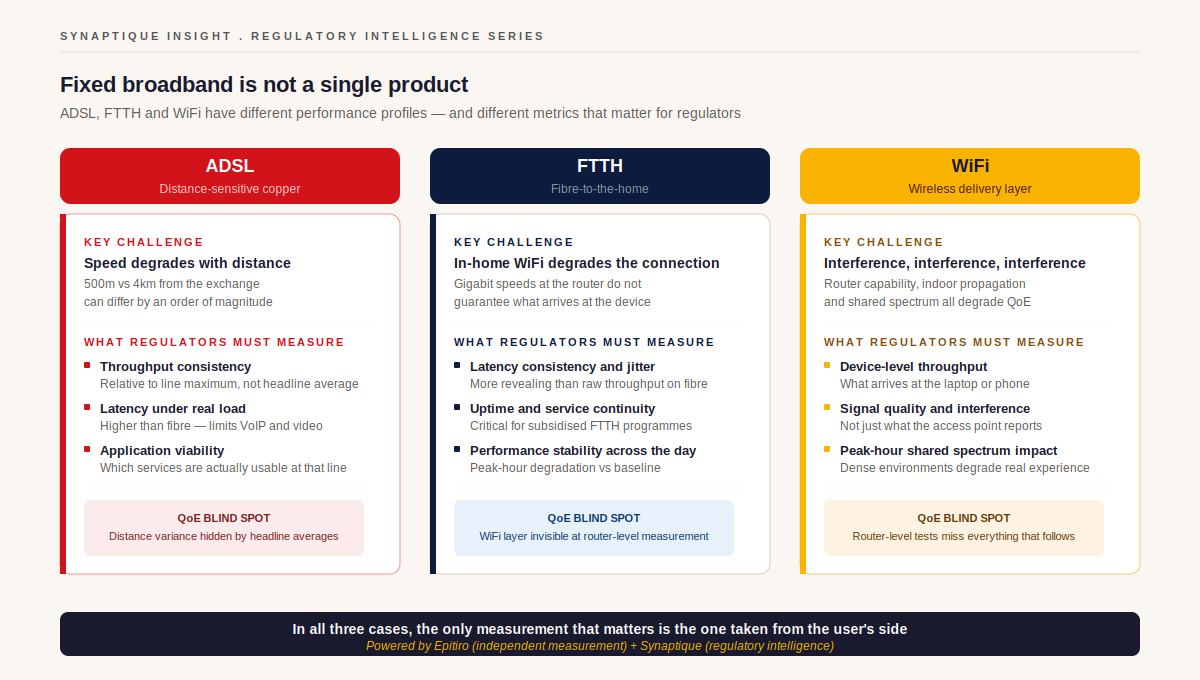
ADSL
ADSL connections are inherently distance-sensitive. A line 500 metres from the exchange and a line 4 kilometres away are technically on the same product but can deliver speeds an order of magnitude apart.
For regulators monitoring ADSL markets, the most important QoS dimension is throughput consistency relative to the theoretical maximum for that line, not a headline sample or average that obscures the variance. Latency and limited upstream capacity can also make ADSL connections less suitable for services such as voice-over-IP or video conferencing. Monitoring QoE on ADSL means understanding which applications are even viable on that access type.
FTTH (fibre-to-the-home)
FTTH networks can be capable of very high speeds, including symmetric services where offered, but deployment quality and in-home condition can still affect the user experience.
The metrics that expose problems on FTTH are different from ADSL: latency consistency and jitter matter more than raw throughput (which should be high), and the critical questions are around reliability over time – uptime, service continuity, and performance stability across the day.
For regulators overseeing subsidised FTTH rollout programmes, continuous uptime monitoring is as important as speed measurement, because the public funding case for FTTH rests on availability, not peak capability.
Wi-Fi
Wi-Fi introduces a layer of complexity that neither ADSL nor FTTH measurement fully captures.
Many regulators measure at the modem or router level and treat the Wi-Fi segment as the customer's problem, but in practice, the experience a user receives at their laptop or phone is the one that matters, and Wi-Fi interference, router capability, and indoor propagation can degrade a technically compliant FTTH service to something that feels like a much inferior product.
For regulators concerned with QoE rather than QoS, Wi-Fi-layer monitoring, measuring what a device actually receives rather than what the access point theoretically provides, is increasingly important.
What meaningful fixed broadband benchmarking actually requires
Across all three fixed access technologies, a benchmarking framework that gives regulators genuine oversight needs to satisfy three conditions that traditional monitoring models have consistently struggled to meet.
Continuous monitoring rather than periodic
Drive tests and annual benchmarking campaigns produce snapshots. Regulators can benefit from a longitudinal record that captures peak-hour degradation, seasonal variation, and long-term service trends. A single measurement date tells you what happened once. A continuous dataset tells you what the service actually is.
User-side rather than network-side
Measuring inside the operator’s infrastructure tells you what the network is capable of delivering.
Measuring from outside it (using an agent that connects exactly as a customer device would) tells you what users actually receive, including the effects of Wi-Fi, indoor propagation, and application-layer behaviour. For understanding QoE, this measurement point is especially important.
Operator-agnostic monitoring
For regulators whose mandate includes enforcement, public reporting, and accountability to international funders, the independence of the underlying data becomes increasingly important. Data generated by the operator’s own tools, or requiring the operator’s co-operation to collect, cannot serve as the evidentiary basis for a compliance finding or a funding verification report. The measurement must come from outside the relationship it is evaluating.
This is where Epitiro comes in
Epitiro is a broadband performance monitoring specialist and one of Synaptique’s official technology partners. Their approach addresses all three of the requirements above through a cloud-based, plug-and-go agent architecture that is specifically designed for the regulatory context.
Epitiro agents are deployed at selected locations (homes, businesses, public institutions) and connect to broadband services exactly as a standard user device would. They sit entirely outside the operator’s network, require no in-line hardware installation, no in-country server infrastructure, and reduced reliance on operator co-operation. Once plugged in, they measure continuously: download and upload throughput, latency, jitter, availability, accessibility, and reliability over time, across ADSL, FTTH and Wi-Fi access technologies.
The result is a real-world QoE picture that is genuinely independent and continuously updated. It captures peak-hour congestion. It detects Wi-Fi-layer degradation distinct from access network performance. It generates the kind of longitudinal, operator-agnostic dataset that regulators can use in enforcement proceedings, in compliance reporting, and in demonstrating to international funders that publicly subsidised broadband programmes are actually reaching users at the quality levels committed to.
The Botswana Communications Regulatory Authority runs fifty Epitiro agents across Gaborone, using the data to set firm QoS benchmarks and hold operators accountable to them.
Where Synaptique wraps around it
Independent field measurement is the foundation, but it is not the whole solution. Raw QoE data, however well gathered, requires an analytics layer to become regulatory intelligence. That is where Synaptique’s open lakehouse platform comes in.
Synaptique QoS monitoring platform ingests the continuous measurement streams from Epitiro agents, aggregates performance across operators and geographies, detects anomalies and degradation patterns in real time, and generates the audit-ready dashboards and compliance reports that regulators need to communicate with government, with funders, and with the public.
The measurement layer and the analytics layer are distinct but complementary – Epitiro provides the independent, real-world data; Synaptique transforms it into the regulatory intelligence that drives decisions.
Together, the two platforms give a regulator something it has historically been very difficult to obtain – a complete, continuously updated, independently verified picture of fixed broadband quality across its entire market, at a cost and scale that is realistic for emerging-market regulatory authorities.