The cost barrier to independent broadband monitoring is changing
For many regulatory authorities, the perceived cost of independent QoS monitoring has been one of the main reasons for not deploying it. This assumption was reasonable when it was formed. It is no longer true, and the gap between perception and reality may now be holding some regulators back from building the evidence base they need.
Ask many telecom regulators why they have not yet deployed independent ADSL, FTTH and Wi-Fi monitoring across their market and, somewhere in the answer, you will hear the same concern. It’s too expensive. The hardware is costly. The in-country server infrastructure is beyond the budget.
The specialist IT team required to operate it does not exist internally and cannot be recruited within the available envelope. The project is something the authority would like to do, in principle, but cannot realistically afford.
This is a perfectly reasonable objection, if the reference point is the traditional in-line monitoring model. That architecture genuinely was expensive. Physical probes at key network points, in-country servers to process the data, dedicated IT staff to manage the infrastructure, and ongoing maintenance costs that continued long after deployment added up to capital and operating budgets most emerging-market regulators could not sustain. The perception that independent monitoring is a premium capability is a direct legacy of that model.
But the architecture has changed. And the cost structure that came with it has changed even more.
Where the old cost structure came from
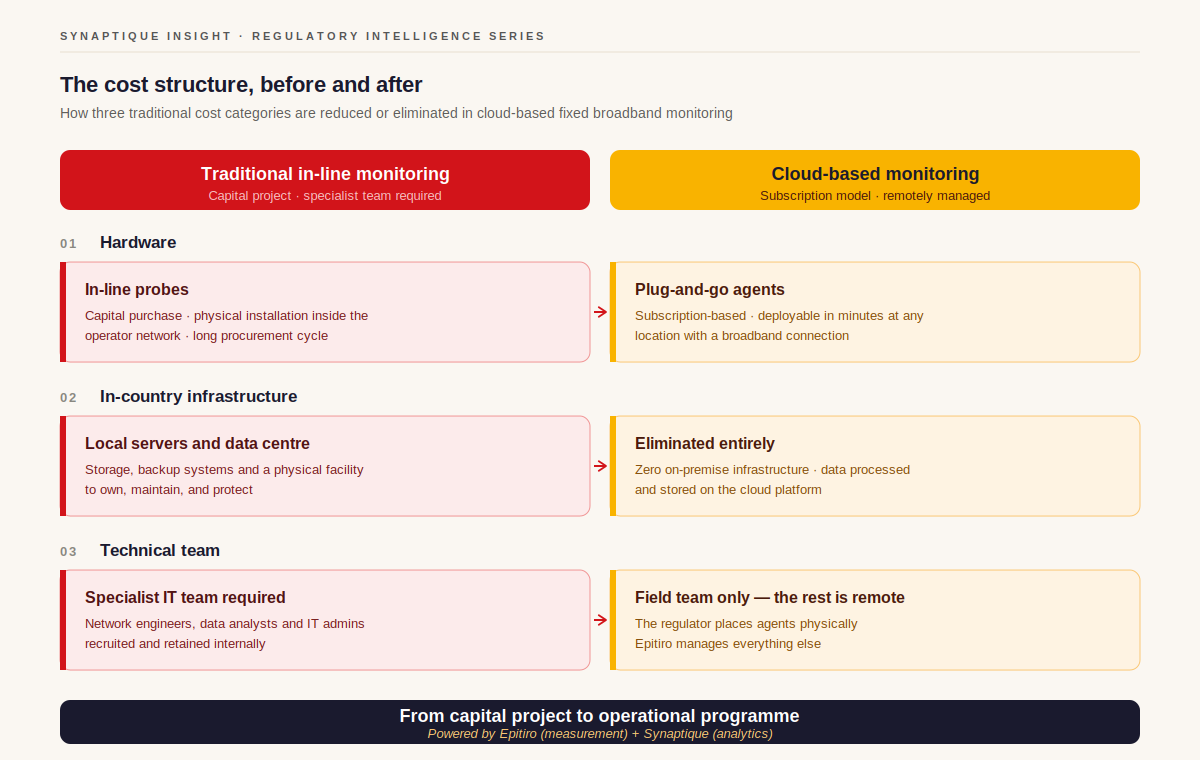
Traditional in-line fixed broadband monitoring carried three categories of cost, each significant in its own right.
- The hardware: Physical probes installed within operator infrastructure, each requiring procurement, configuration, and physical deployment.
- The server infrastructure: Required to aggregate and store the data those probes produced typically in-country, typically bespoke, often expensive to establish and maintain.
- The specialist technical team: Often the largest ongoing cost, IT staff capable of managing the servers, network engineers to maintain probe connectivity, and data analysts to produce anything useful from the raw output.
For a national regulator committing to monitor fixed broadband performance continuously across a meaningful geographic area, the combined cost of these three layers placed the programme firmly in the capital-project category. It required multi-year budget approval. It required parliamentary or ministerial sign-off. It required internal technical capacity the authority often did not have. And once deployed, it created recurring operational cost that could put pressure on the annual regulatory budget.
This is the architecture that helped shape the “too expensive” objection. But it’s no longer the only model available.
“The perception that independent fixed broadband monitoring is a premium capability is a direct legacy of an architecture that no longer defines what is available.”
What a cloud-based architecture actually costs
The shift to cloud-based, agent-driven monitoring has not just made independent QoS monitoring more accessible, it has fundamentally rewritten the cost structure. Each of the three traditional cost categories is either dramatically reduced or eliminated altogether.
Hardware costs can be significantly reduced.
Cloud-based monitoring uses lightweight plug-and-go agents, supported by a subscription-based platform. Regulators can deploy agents at selected locations, or in some cases use existing compatible hardware, while paying a predictable monthly subscription for the monitoring service. The cost of adding a new monitoring location can therefore be more manageable than building a traditional in-line monitoring infrastructure.
The need for in-country infrastructure to host the monitoring platform and store the data can be removed.
The cloud platform that aggregates, stores and serves the measurement data is managed externally. This means the regulator does not need to equip a server room, buy storage infrastructure, commission backup systems or build a local data centre to run the monitoring system.
Local test endpoints may still be used for some measurements, but the platform itself does not require the regulator to build and maintain its own in-country server environment.
The need for a specialist technical team is reduced.
This is the shift most regulators underestimate. Cloud-based monitoring is managed by the platform provider. Agents are configured centrally. Data is processed centrally. Dashboards, reports, and troubleshooting are handled by the provider’s team, remotely. The regulator does not need to hire network engineers, data analysts, or IT administrators to operate the programme. The internal requirement reduces to something far more achievable: a team on the ground able to physically place and, if needed, relocate the agents.
Who does the work
This last point deserves more attention than it usually receives, because it is the one that most directly addresses the regulatory cost constraint. Most authorities do not struggle to find field staff; they struggle to find deep technical specialists they can retain on public-sector salaries. The traditional monitoring model required exactly those specialists. The cloud-based model can reduce this dependency.
In a cloud-based deployment, the regulator’s role can be more focused – identify the locations where monitoring is required, place the agents physically (a task that requires no technical expertise, the device plugs into any standard broadband connection and begins operating immediately), and relocate or replace agents if the regulatory coverage strategy evolves.
Much of the configuration, data collection, reporting, alerting and troubleshooting can then be managed remotely by the platform provider, with the analytics layer helping turn the data into usable regulatory insight.
For a national regulatory authority, this is a fundamentally different operational profile. It means the programme can be deployed with existing internal staff rather than new specialist hires. It means the running cost is predictable and contained. And it means that scaling the programme, from ten agents in the capital to fifty agents nationwide, does not require a proportional scaling of internal headcount or technical capability.
The real cost to consider: doing nothing
There is a cost that rarely enters the budget conversation, and that is the cost of not monitoring independently at all. A regulator that cannot produce independently gathered evidence of ADSL, FTTH and Wi-Fi performance can face practical consequences.
Funding discussions can become harder when evidence of delivery cannot be produced. Enforcement action can be more difficult when it relies on disputed operator-submitted data. Reporting obligations to government and ministries become harder to meet credibly. And public trust may be harder to build when independent verification is limited.
Weighed against the actual cost of a cloud-based monitoring deployment subscription-based, no in-country infrastructure, managed technical operations, the economic argument has shifted decisively. Independent monitoring has moved from a premium capital project to an affordable operational programme.
Regulators that adopt these models early can build the kind of evidence base that governments, funders and citizens increasingly expect.
Epitiro and Synaptique: cost-efficient by design
Epitiro is the technology partner behind this new cost architecture. Its cloud-based platform is specifically designed for the regulatory context, subscription-based plug-and-go agents, no in-country infrastructure required to host the monitoring platform or store the data, and remote technical support that includes data analysis, dashboard creation, and troubleshooting. Regulators place the agents at the locations they need to monitor. Epitiro handles everything else.
This division of responsibility can make independent monitoring more viable for regulators that may not have been able to support a traditional in-line deployment.
The Botswana Communications Regulatory Authority operates 50 Epitiro agents across Gaborone on this model, continuously generating QoS performance data, supporting benchmarking and operator accountability without the capital cost or specialist headcount associated with traditional in-line monitoring deployments.
Synaptique’s open lakehouse analytics platform sits on top of Epitiro’s measurement data to deliver the regulatory intelligence layer: cross-operator benchmarking, anomaly detection, compliance reporting, and the audit-ready dashboards that allow authorities to communicate effectively with governments, funders, and the public. The combined deployment delivers a complete, continuously updated, independently verified picture of fixed broadband delivery at a cost and operational profile that makes it realistic for the regulators who need it most.
Want to see the actual cost profile of an independent monitoring deployment?
Synaptique and Epitiro Synaptique and Epitiro hosted a joint webinar on this topic: “How can regulators benchmark their fixed broadband QoE - affordably, independently and with full control?.” The session explored why operator-reported data and traditional monitoring methods are no longer sufficient, and how independent Quality of Experience (QoE) measurement provides a more accurate view of network performance. Watch the recording. We have also published a full Q&A covering every question raised by attendees during the session (including answers on pricing, methodology, agent deployment, and which regulatory authorities are already using the platform). Read the full Q&A.