Why operator self-reporting is no longer enough for telecom regulators
Picture a scenario that could play out in regulatory offices across emerging and developing economies.
A national telecom authority has just completed a review of fixed broadband performance across its market. The data in front of the room, supplied by the operators themselves, shows that average download speeds are comfortably above the licensed threshold, availability is north of 99%, and service quality is broadly in line with advertised commitments.
Then someone in the room asks: how do we actually know that is true?
It is a simple question, and for many regulators, the answer may not be as clear as it needs to be.
The operator-submitted data may be difficult to independently verify. The regulator may not have continuous, real-world measurements of what end users actually experience. And if a government minister, a development bank or an international donor asks for proof that a publicly-funded fixed broadband programme is delivering results, the regulator may find itself relying heavily on data supplied by the party it is expected to hold accountable.
This is one of the fundamental challenges at the heart of telecom regulation today, and it is becoming harder to ignore.
The limits of self-reporting
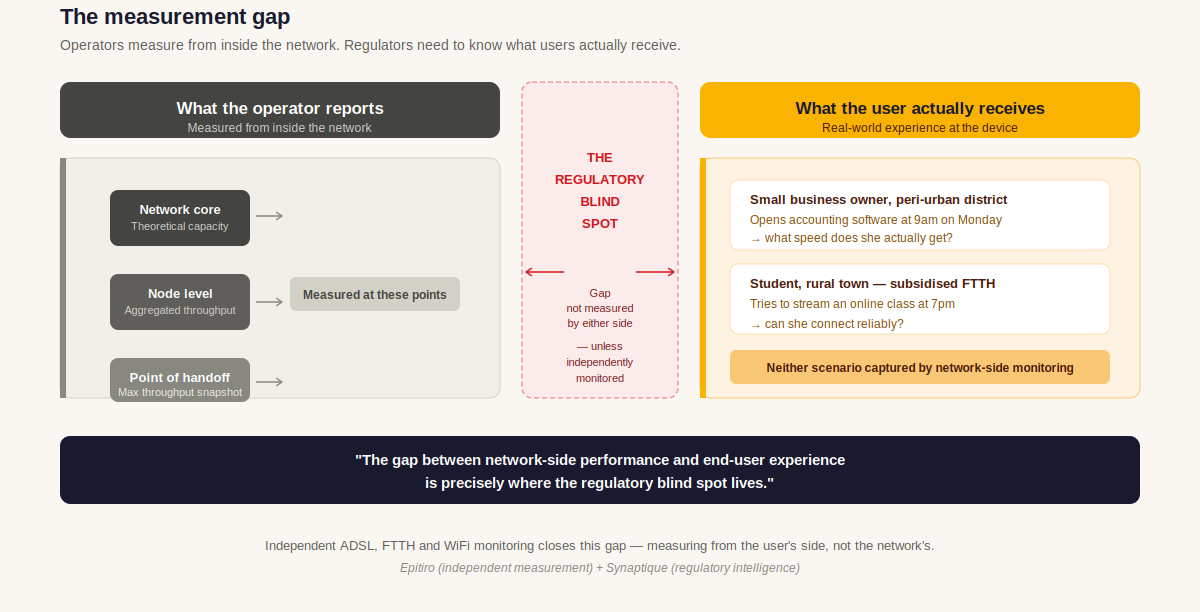 Telecom operators are commercial entities, and their reporting is naturally shaped by their own operational, commercial and compliance priorities. This does not mean operators deliberately falsify data, but it does mean that operator-reported metrics and independently measured user experience are not always measuring the same thing.
Operators typically measure network performance from inside the network, at the core, at the node level, or at the point of handoff. What that captures is theoretical or maximum throughput under controlled conditions. What it does not capture is what a small business owner in a peri-urban district actually gets when she opens her accounting software at 9am on a Monday morning, or whether a student in a rural town, served by a subsidised broadband programme, can reliably stream an online class.
"The gap between network-side performance and end-user experience is where the regulatory blind spots can emerge."
Public investment demands public accountability
The stakes have risen sharply in recent years. Across emerging markets, governments are committing large sums to national broadband programmes, often supported by universal service funds (USFs), development finance institutions or international donors such as the World Bank and the African Development Bank.
These funding mechanisms come with accountability requirements. Funders increasingly want to see credible evidence that investment is reaching end users and delivering measurable impact. Independent performance data can play an important role in helping to give regulators this confidence.
A regulator that cannot produce the evidence may find itself in an uncomfortable position. It may struggle to assure government stakeholders that programme targets are being met. It may find it harder to credibly report to an international donor. And enforcement action against an underperforming operator can become more difficult if the regulator does not have independent data to back its case.
These are not edge cases. They represent a broader shift in how regulators think about their evidentiary role.
Why the old measurement models do not scale
Regulators are aware of this problem. One traditional response has been to deploy in-line hardware at key network points, with physical probes that sit within the operator's infrastructure and capture traffic-level data.
In markets with mature regulatory infrastructure and reliable technical capacity, this model can work. But for many emerging-market regulators, it introduces three significant constraints.
Cost
In-line hardware deployments can require substantial capital expenditure, in-country server infrastructure and ongoing IT support. For regulators operating on constrained budgets, this can be difficult to justify or sustain at a meaningful scale.
Dependence on operator co-operation
In-line monitoring requires physical access to the operator's network. In practice, this can mean regulators are reliant on the technical co-operation of the very entity they are monitoring – a structural conflict that can delay or complicate measurement.
Point-in-time snapshots rather than continuous data
Many regulators still rely on periodic drive tests or spot-check campaigns. These can be expensive, infrequent, and poorly suited to generating the kind of continuous, longitudinal record needed for enforcement, compliance reporting or trend analysis.
The result is a measurement gap that can leave most regulators with neither the data quality nor the operational coverage to fulfil their oversight mandate with confidence.
What independent, real-world monitoring actually looks like
The shift now underway in progressive regulatory markets is towards a fundamentally different architecture: monitoring that connects to the network, behaves like a real user device and measures the service as an end user would experience it.
This approach, sometimes called client-based or cloud-native QoS monitoring, has several structural advantages over legacy models. Agents connect to broadband services exactly as a standard customer device would, which means they measure real-world performance and interact with the network the same as a user would. They do not require any in-line network access, which reduces reliance on operator co-operation. And because they run continuously on cloud infrastructure, they generate the uninterrupted longitudinal dataset needed for meaningful benchmarking, enforcement and reporting.
Solutions such as Epitiro’s independent broadband monitoring platform are built on this model, providing regulators with plug-and-go agents that can be deployed quickly and start generating reliable, real-world performance data across multiple operators.
Critically, this architecture is significantly more cost-effective to deploy at scale, which makes it viable for regulators in markets where traditional in-line models may have been difficult to sustain. A targeted deployment of plug-and-go agents across a capital city or priority coverage area can generate a continuous, independent picture of broadband performance across multiple operators, with no in-country storage or control server infrastructure, no specialist IT team, and no dependency on operator network access.
The analytics layer: turning measurements into regulatory intelligence with Synaptique platform
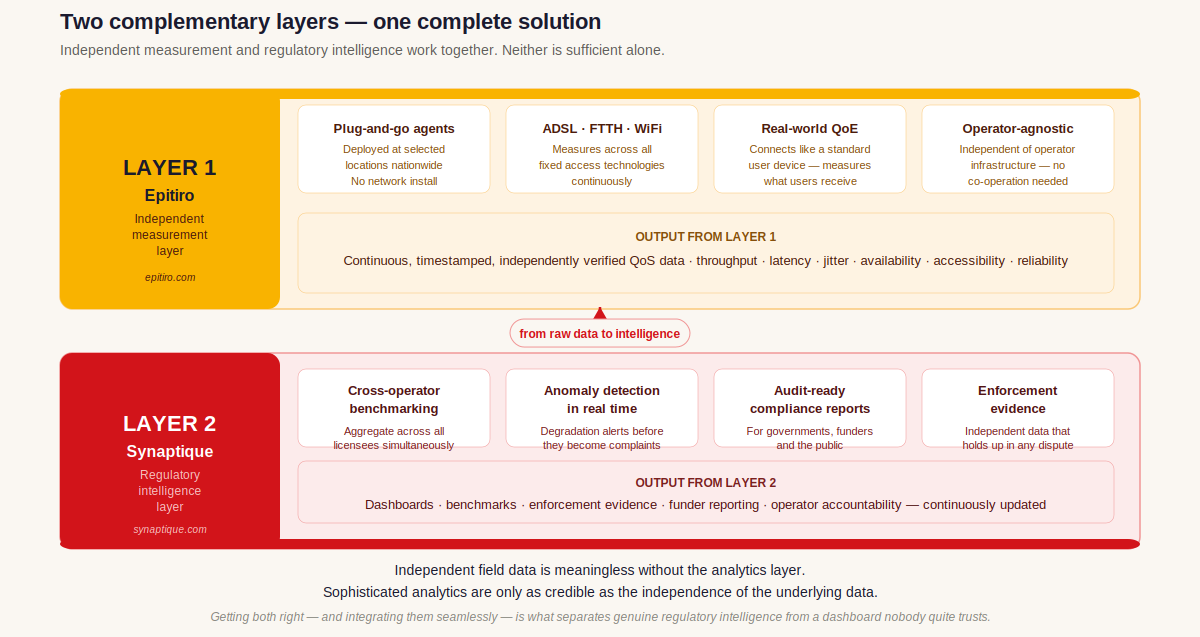 Raw measurement data, however independently gathered, is most valuable when a regulator can interrogate it, contextualise it, and act on it. This is where the connection between independent field measurement and advanced data analytics becomes decisive.
At Synaptique, we work with regulatory clients to build the analytics layer that sits on top of independently gathered QoS data, ingesting continuous measurement streams, aggregating performance across operators and geographies, detecting anomalies and degradation patterns in real time, and generating the audit-ready dashboards and compliance reports that regulators need to communicate with government, funders, and the public.
The measurement layer and the analytics layer are distinct but deeply complementary. Independent field data becomes more powerful when regulators have the tools to process and present it. Sophisticated analytics are only as credible as the independence and quality of the underlying data. Getting both right, and integrating them seamlessly, is what separates a genuine regulatory intelligence capability from a dashboard that does not fully support decision-making.
"Independent field data becomes more powerful when regulators have the tools to process and present it. Sophisticated analytics are only as credible as the independence and quality of the underlying data."
The direction of travel is clear
Telecom regulators across the world are increasingly moving towards models that use independent, continuously gathered, operator-agnostic QoS data to strengthen oversight.
Governments with public money committed to broadband rollout are asking for stronger evidence of delivery. International funders are also placing greater emphasis on measurable outcomes and credible reporting. And many forward-looking regulatory authorities recognise that their credibility depends on having a clearer, independent view of what users are actually experiencing.
The technical and economic barriers that once made this difficult have also reduced. Cloud-based agent architectures have made independent monitoring more affordable and scalable for regulators that could never have sustained a traditional in-line, or local infrastructure deployment.
The question is increasingly less about whether independent QoS monitoring is feasible, and more about how regulators can implement it in a practical, proportionate way – and how they build the analytics capability to turn that data into genuine regulatory intelligence.