#Your webinar questions answered: what regulators actually asked about independent fixed broadband monitoring
During our joint webinar with Epitiro, attendees submitted some of the most practical questions we have received on fixed broadband QoE monitoring. Here are all of them, answered in full.
The questions from our webinar audience stood out for one reason: they were not abstract. They came from regulators actively thinking about deployment — about costs, methodology, and how to make independent monitoring work inside a real regulatory authority with a real budget. We have grouped the questions by theme below, with answers from both the Epitiro and Synaptique teams. At the end, we have also shared the poll results from the session, which tell a story of their own about where regulatory monitoring programmes actually stand today..
Understanding QoS, QoE and network performance
Q: How does network congestion affect broadband quality?
A: The internet is a shared resource, like a road. When too much traffic is trying to travel on a narrow highway you get congestion and the quality and speed of the connection is reduced. The remedy is to increase the capacity of the infrastructure.
Q: How does QoE work and how can we measure it?
A: Quality of Experience represents what a user would typically experience when using a service. Is the service available? Can it be successfully accessed? What is the quality of the service received? These elements can all be measured and quantified by sampling and statistics.
Measurement tools and methodology
Q: What tools are commonly used to measure broadband performance?
A: Epitiro offers an extensive library of user-selected tests, some of which are commercial speed tests such as M-Lab by Google, Fast by Netflix, or Ookla. You can also set up custom HTTP and FTP tests. These tests are all highly configurable: you can specify a server to connect to, an IP address to ping, a DNS to resolve, or even a port range to scan. Once you have decided what you want to measure and when, you can build a test sequence yourself — or we can build it for you.
Q: At what point does Epitiro connect to the licensee network, and how many agents are needed?
A: Epitiro connects at the same point a user would connect — think of the agent just like a phone or a laptop connecting as a client over Ethernet or Wi-Fi. Ethernet is used when you want to know the performance coming into a building or home; Wi-Fi when you want to measure end-user experience on a wireless network. The number of agents depends on the scope of the measurement project — often not as many as you might think. You want to sample the network by taking a series of measurements across time of day and in different locations. The exact number depends on the variation in performance measured and the statistical confidence by which you want to express your results.
Q: Where will the agents be located, at the operator or elsewhere?
A: The agents can be located virtually anywhere that has an Ethernet or internet connection. Typically, regulators will get started by deploying a few of the agents amongst their staff. so that they can get familiar with it internally first. Then sometimes they will ask for volunteers from a population set, and sometimes they will ask the carrier or ISP to help.. We find that regulators are often interested in locating them in places of public interest, like schools or libraries where often the government is subsidizing or paying for the service. And they are obviously interested in the standard of service to their citizens across different cities.
Q: Can you explain the technical architecture of the agent?
A: The 6177 agent is based on a Raspberry Pi (CM4) platform. It has a 1 Gbps (PoE) Ethernet interface and a Wi-Fi 7 (Intel bn200) interface. The operating system is Linux/Ubuntu. A spec sheet can be provided on request.
Q: Can this tool integrate drive test logs?
A: Drive test logs often refer to data from cellular measurement devices, including QXDM logs (layer 2 network data). Our platform does not decode or read this data in its native form. Some of the data could be integrated once read with a QXDM or other drive test tool, but this is not primarily a cellular drive test solution.
Benchmarking, KPIs and target thresholds
Q: What methodology is used to benchmark operators and establish QoE KPI target values? For example, how are target thresholds determined for key performance indicators such as latency (ping), jitter, web page load time, and other QoE metrics?
A: Most regulators are interested in knowing if their citizens are getting the advertised performance that they are paying for. If someone is paying for a 100Mbps service, is that the performance they are consistently receiving. So, many target thresholds are set against advertised rates. Other times a govenrment might be subsidizing the Operators to deploy service and they require certain performance goals to be met. Things like, network availability and roll out. If an operator is taking government money, or receving tax-breaks, to meet certain coverage or performance targets or subsidize technology rollout, then the regulator has an interest in making sure that those defined targets are delivered.
Q: How are benchmark values and target thresholds determined for key QoE metrics such as latency, jitter, packet loss, and video streaming performance?
A: The technical methodology is to sample, or measure, the actual performance delviered. The KPIs can be things like 50Mbps downlink throughput measured with a confidence interval of 95%. or Packet Loss less than 2% (again with a confidence interval defined). Once the technical performance targets are agreed, then a sampling methodology can be defined for the measurement campaign. Often the easiest thing to do is run a Pilot measurement campaign to get a quick idea of how variable the performance data will be. If you want higher confidence intervals then you may need a higher number of samples. Often this is a practical trade-off between precision (more measurements) and time/cost (fewer measurements). If you start a program you will quickly learn where you need to focus to drive improvements to results, which is really the goal. Once you start measuring, you will quickly learn where you should focus, what questions to ask the operators, and what reasonable goals you can set for improving performance. You don't need all the answers before you start measuring. Starting a measurement program will get you to the answers.
Q: How is the score value calculated based on speed and latency measurements?
A: The "Score" is a customisable setting. Users can create different scoring profiles. It is typically a weighted summation of key variables such as download and upload speed, with latency, packet loss, or other KPIs as inputs.
Q: Does this tool support the integration of operators’ QoS KPIs?
A: Yes. You can set any thresholds and KPI targets, then configure alerts and alarms and measure against those.
Q: Is there a possibility to validate the QoS KPIs reported by operators using QoE measurements?
A: Yes. If a carrier or ISP claims they are delivering a certain quality of service, deploying a few Epitiro agents allows you to sample the service. If the data is consistent with what the operator reported, it validates their numbers. If it is not, you can dig deeper to understand the reasons for the discrepancies — often because operators use a different methodology to present data in the best light possible for them.
Q: Some ISPs have Fair Usage Policies. How is this accounted for?
A: So called "Fair Usage Polcies" are deployed by operators to limit the amount of data that a user consumes. They are often a way of limiting usage, while still advertising 'unlimited' plans, which can be deceptive. Where an operator limits data usage or provides rate-caps at certain volume thresholds, it is improtant for regulators to know that their citizens are being fairly treated and are getting what is being advertised. We can execute test cases that will measure the data volume and compare the rates (throughput) as the data rates are reached. Typically, most regulators worry about decptive advertising, where an operator advertises unlimited data with highspeeds (+100Mbps) but then implement policies to rate-cap a customer (say to <10Mbps) after they have used 1GB of data in a month. We can design tests and collect the data to show what is happening. It is then up to the regulator to decide if this aligns fairly with the operators advertising and marketing.
Regulatory data and reporting
Q: What types of data must operators submit to the regulator, and how often?
A: This depends on the country. There is no universal framework. But generally, operators submit reports on KPIs that reflect service quality: coverage, download and upload speeds, latency, availability, and so on. Frequency varies too, typically monthly for performance indicators and quarterly or annually for broader market data.
Cost, deployment and data retention
Q: What are the costs associated with acquiring the solution?
A: You can find the pricing for the Epitiro agents and subscription services here: https://www.epitiro.com/pricing/ The cost of the agent is $299. We deliberately chose the most appropriate piece of low cost hardware to make sure our solution remains cost effective and affordable for regulators. The subscription service is $15 per agent per month or $180/year and that includes everything. This means there isn't any significant capital expenditure required up front and explains why we have some very small operators as clients who can still afford the solution.
Q: How much are the CAPEX costs in USD?
A: There is no real CAPEX required. You purchase agents at $299 each and pay the annual subscription at $180 per agent. If a customer wants to make a CAPEX purchase, agents can be bundled with multi-year subscriptions for a one-off purchase.
Q: How long is the data retention period?
A: Data can be kept for as long as you need. Cloud storage is relatively inexpensive and local back-ups can always be arranged.
Scalability, security and regulatory coverage
Q: How scalable is the platform, and what cybersecurity controls are implemented?
A: It readily scales to thousands of connected agents. It is serverless technology, so no additional infrastructure is required as more devices are added.Additionally, on security. each agent has a firewall, with control over all ports. Additional, (Linux) endpoint security applications can be installed, of required.
Q: Which regulators are currently using the solution in Africa?
A: In Africa, the Botswana Communications Regulatory Authority (BOCRA) and l’Agence Nationale de Réglementation des Télécommunications (ANRT) in Morocco are currently using the Epitiro solution. The platform is also used by regulators in Trinidad and Tobago and Eastern Caribbean countries.
What the poll told us
We ran a three-question poll during the session. The results say something honest about where most regulatory monitoring programmes stand today.
Poll 1: Do you currently have an independent fixed broadband monitoring programme?
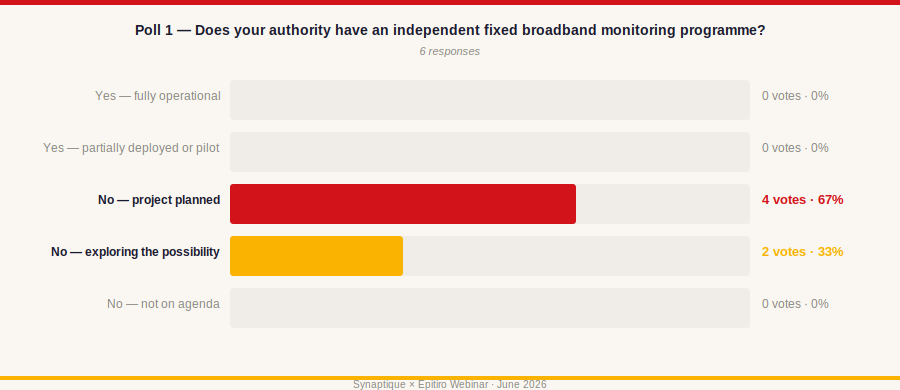
Two respondents said they are exploring the possibility. Four said they have a project planned. Nobody reported a fully operational programme — which matches what we hear in direct conversations. The interest is there. The projects are forming. The operational deployments are still few.
Poll 2: What is your expected timeline?
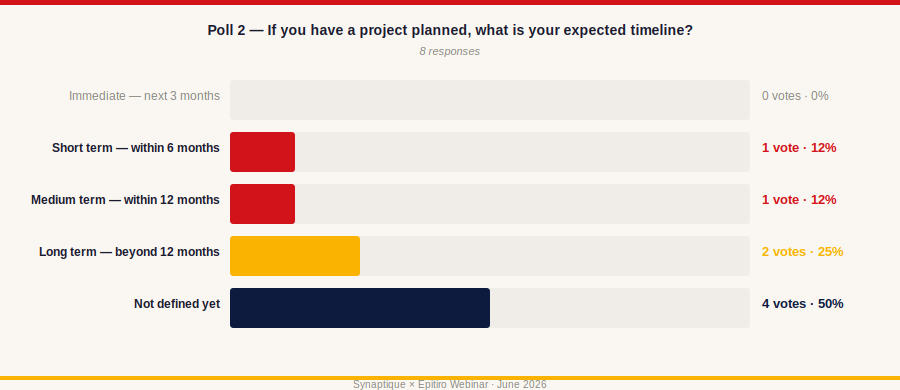
Four said ‘not defined yet’, two said ‘long term’, one said ‘medium term’, and one said ‘short term’ (within 6 months). The single short-term response is the one to notice — that is an authority close to moving.
Poll 3: What is the biggest obstacle?
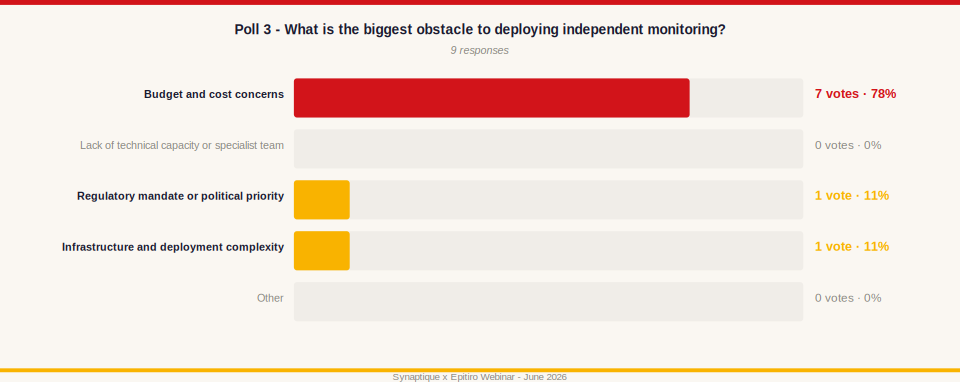
Budget and cost concerns dominated: seven out of nine respondents selected it. One cited infrastructure complexity. One cited regulatory mandate or political priority.
“Seven out of nine respondents cited budget as their main obstacle — against a solution that costs $15 per agent per month with no in-country infrastructure required.”
If you want to go further
If something raised here applies to your authority’s situation, the best next step is a short conversation. Both teams are available for a 30-minute call. Book a call here.