Your Data Is in Six Systems and None of Them Agree
Ask three departments in a large organisation the same factual question (how many active customers do we have, what did we sell last quarter, how much did that project actually cost) and you will often get three different numbers. Not because anyone is wrong, and not because anyone is lying. Because each department is answering from its own system, and the systems don’t agree.
This is so normal that most organisations have stopped noticing it’s a problem. They’ve built a whole apparatus around it: the monthly reconciliation meeting, the analyst who “owns the real number,” the spreadsheet that quietly becomes the source of truth because at least it’s one place. That apparatus is expensive, slow, and a sign of something broken underneath. The broken thing is that the organisation cannot see itself whole.
How you ended up here
Nobody designed this. It accumulated.
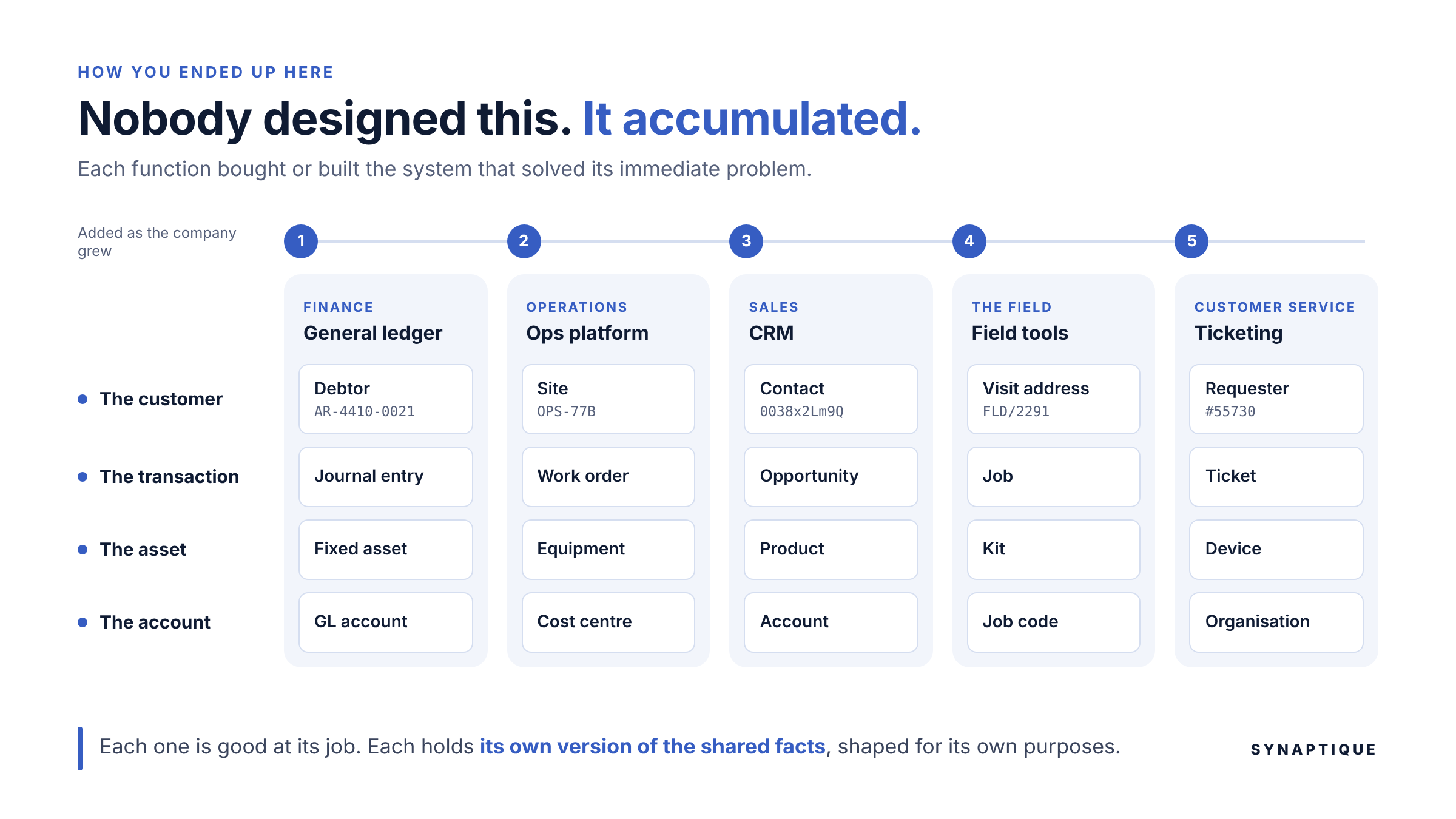
A company grows, and each function buys or builds the system that solves its immediate problem. Finance gets a system built around the general ledger. Operations gets one built around whatever operations does. Sales gets a CRM. The field gets its own tools. Customer service gets a ticketing platform. Each of these is good at its job, and each one holds its own version of the shared facts (the customer, the transaction, the asset, the account) shaped for its own purposes.
The result, after a decade, is six systems (or sixteen) that each hold a piece of the truth and none of which holds all of it. The customer in the CRM and the customer in billing are the same person with different identifiers, different fields, and no reliable link between them. Each system is internally consistent and collectively incoherent. The organisation’s knowledge about itself is real but scattered, and scattered knowledge is nearly as hard to act on as no knowledge at all.
What the silos actually cost
The cost isn’t mainly the reconciliation meetings, annoying as they are. It’s the decisions you can’t make and the problems you can’t see because no one system holds the whole picture.
Some costs are visible. Revenue that leaks in the gaps between systems, a service delivered in one system but never billed in another, a discount applied in one place and not reconciled in a third. Fraud that hides in the seams, because the signal that would catch it is split across two systems that don’t talk. Compliance findings that arrive late because assembling the evidence meant manually stitching exports together.
Other costs are quieter and larger. The question nobody asks because answering it would take three weeks of data-wrangling, so the decision gets made on instinct instead. The pattern across the whole business that no one sees because every team only sees their slice. The analyst's time is spent not analysing but reconciling, copying, matching, and arguing about whose number is right. An organisation that spends its analytical capacity assembling the picture has little left over to actually look at it.
Why the obvious fixes don’t fix it
Two instincts come up whenever this is named, and it’s worth saying why neither quite works.
The first is: consolidate everything into one system. Rip out the six, put in one platform, one source of truth. Organisations try this, and it’s brutal , a multi-year migration, enormous cost, and real operational risk, because those six systems are load-bearing and ripping them out is open-heart surgery on a running business. More to the point, it usually fails or stalls, because the moment you’ve consolidated, a new need arrives, a new tool gets bought, and the sixth system is reborn as the seventh. Consolidation fights the tide; the tide wins.
The second instinct is: build a data warehouse, copy everything into it, report from there. This is better, and many organisations do it. But the classic warehouse has its own problems at scale: it's expensive to keep years of detail in, rigid to change when a new source appears, and it often becomes yet another system with yet another version of the numbers, now a day or two stale. You’ve added a system, not removed the disagreement.
The real problem underneath both is subtler than “too many systems.” It’s that the data is trapped in system-shaped containers, in formats owned by vendors, keyed in incompatible ways, and there’s no layer where it can sit together, at full detail, queryable as a whole, without first being wrenched out and consolidated. Solving that is a different move than either consolidating or warehousing , and it’s what the companion piece is about.