Usage-to-Bill Gaps: Service Delivered, Usage Not Billed
Here is a quiet, expensive truth most operators live with and few state plainly: not every service you deliver gets billed. The call connects, the data flows, the SMS sends (the subscriber gets exactly what they paid for) and somewhere between the network delivering it and the bill charging for it, a share of that usage simply falls out. The service was real. The revenue wasn’t.
This is the usage-to-bill gap, and it’s one of the hardest forms of leakage to see, because nothing about it looks wrong. The customer isn’t complaining ,they got their service. The network isn’t failing, it delivered. The billing system isn’t erroring, it’s charging correctly for everything it received. The problem is everything it didn’t receive, and a system can’t flag the absence of a record it never knew to expect.
The journey a usage event has to survive
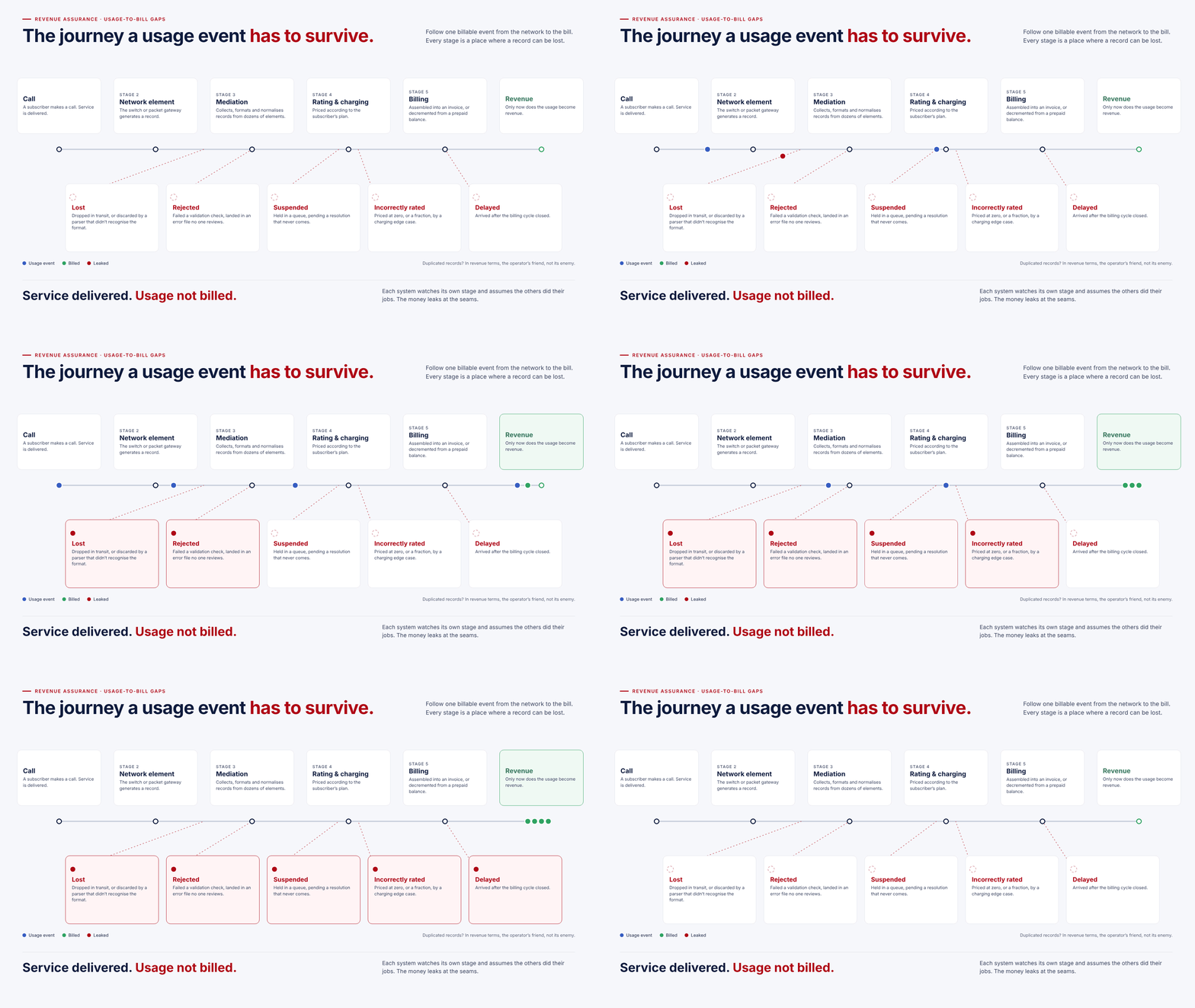
To understand where the gap opens, follow a single billable event from the moment it happens to the moment it appears on a bill. It’s a longer journey than most people outside the network picture, and every stage is a place where a record can be lost.
A subscriber makes a call. The network element (the switch, the packet gateway, whatever handled it) generates a record of that event. That record travels to mediation, which collects, formats and normalises raw records from dozens of network elements into something the downstream systems can use. From mediation it moves to rating and charging, where it’s priced according to the subscriber’s plan. From there to billing, where it’s assembled into an invoice or decremented from a prepaid balance. Only after it survives that entire chain does the usage become revenue.
Now consider what can happen along the way. A record can be lost (dropped in transit between a network element and mediation, or silently discarded by mediation because it arrived in a format the parser didn’t recognise. It can be rejected) failing a validation check and landing in an error file that no one reviews. It can be duplicated (though that’s the operator’s friend, not its enemy, in revenue terms. It can be delayed) arriving after the billing cycle has closed, and either getting rated late or falling outside the count entirely. It can be suspended (held in a queue pending some resolution that never comes). Or it can be incorrectly rated (priced at zero, or at a fraction of what it should be), because of an edge case in the charging logic.
Each of these is a different failure, at a different stage, and each produces the same outcome: service delivered, usage not billed. The money leaks at the seams between systems, which is exactly where it’s hardest to watch, because each system is only responsible for its own stage and assumes the others did their jobs.
Why the systems don’t catch it themselves
The intuitive question is: surely the billing system notices if records go missing? And the answer reveals why this leakage persists; no, it can’t, by design.
Billing charges for what it receives. It has no independent knowledge of what the network actually delivered, so it cannot know that it should have received more. If mediation passes 950,000 records when the network generated a million, billing produces a perfectly correct, perfectly reconciled set of invoices for 950,000 events. Nothing is wrong from billing’s point of view. The 50,000 missing events don’t appear as an error, because an error requires something to compare against, and billing has nothing to compare against except the records it was given.
The same blindness runs through every stage. Mediation knows what it received and what it passed on, but if it’s dropping records on a format error it was never configured to flag, it drops them silently. Rating prices what it’s told to price; if an event arrives mis-classified, rating faithfully applies the wrong price. Each system is internally consistent. The gap only exists in the relationship between what one stage handed off and what the next stage received and no single system owns that relationship.
This is the structural reason usage-to-bill leakage is so persistent. It doesn’t live inside any one system, where that system’s own controls could catch it. It lives in the handoffs between them, in the space no system is watching.
A worked example
Let me make it concrete, built from the shape this problem actually takes rather than any specific operator.
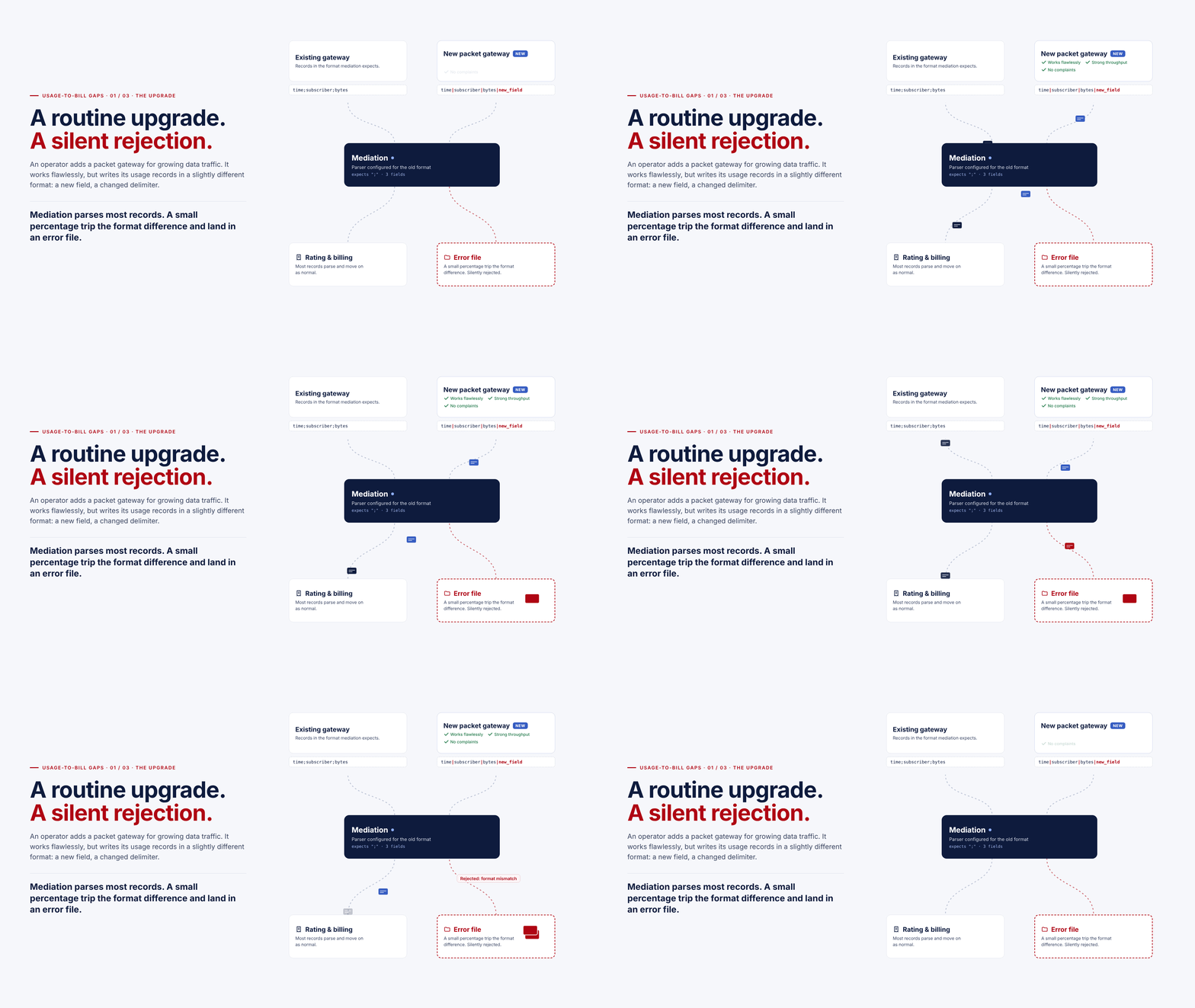
An operator introduces a new packet gateway to handle growing data traffic, a routine capacity upgrade. The gateway works flawlessly: subscribers get their data, throughput is strong, no complaints. But the gateway writes its usage records in a slightly different format from the existing ones, a new field, a changed delimiter, something minor. Mediation, configured for the old format, successfully parses most of these records but silently rejects a small percentage that trip the format difference. Those rejected records go to an error file.
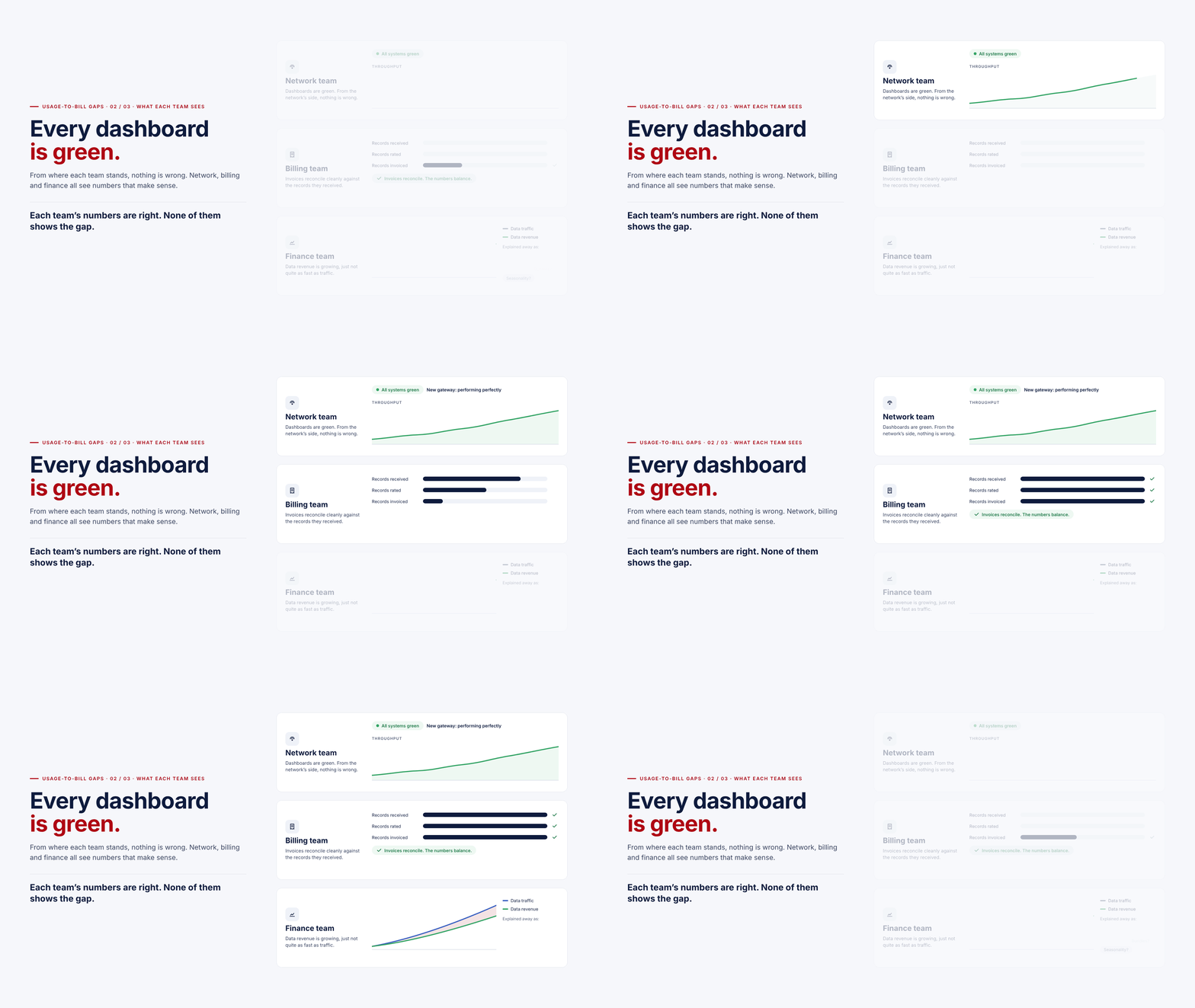
Here is what each team sees. The network team sees a gateway performing perfectly — their dashboards are green, because from the network’s side nothing is wrong. The billing team sees invoices that reconcile cleanly against the records they received — their numbers balance. The finance team sees data revenue that’s growing, just... not quite as fast as the traffic growth would suggest, a discrepancy small enough to attribute to a dozen plausible commercial factors.
No alarm fires anywhere, because no single system has both halves of the comparison. The network knows what it delivered. Billing knows what it charged. Nobody is holding those two numbers next to each other. The leakage continues, invisibly, for as long as it takes someone to think to ask: how many records did the network generate, and how many reached a bill?
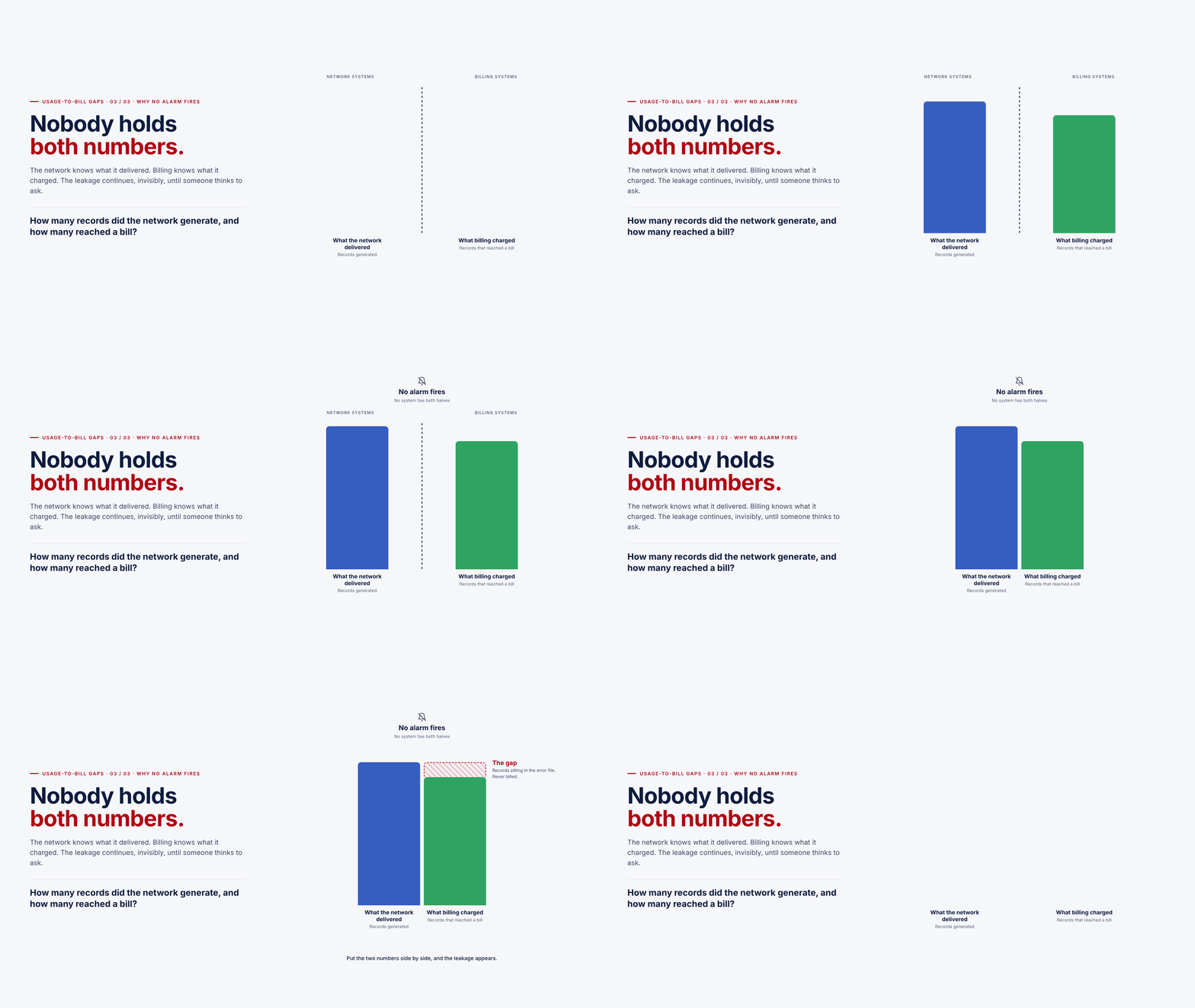
That question asked deliberately, as a reconciliation rather than hoped for as an alarm is the only thing that surfaces this kind of gap. And by the time an indirect symptom (the margin that’s a little soft, the data revenue that’s a little behind the traffic curve) grows large enough to investigate, the gateway has been quietly leaking for months, and that revenue is unrecoverable.
Why traditional controls miss it
Most revenue assurance programmes do have usage-to-bill controls. So why does the gap persist?
Partly because the controls are often aggregate, not granular. Comparing total record counts in and out of mediation for the day will catch a gross failure (a feed that fell over entirely) but not a steady few-percent loss on one record type from one network element, which disappears into the noise of a large daily total. The leak that matters is usually small as a percentage and large as an absolute number, and aggregate checks are built to miss exactly that.
Partly because the controls are rule-based and the network keeps changing. A reconciliation configured for today’s network elements and record formats doesn’t automatically cover the gateway installed next quarter, the roaming partner added next month, or the new service that writes a record type no existing check was written for. Every change is a new opportunity for a gap the controls weren’t designed to see.
And partly because true usage-to-bill reconciliation requires something operators have historically found expensive: holding the network-side records and the billing-side records together, at full detail, long enough to compare them event by event rather than in aggregate. When those datasets live in separate systems with separate retention windows (the network records aged out after weeks, the billing records kept for years) reconciling them at the event level is difficult precisely when you most need to, which is after the fact, when you’re trying to work out where the missing revenue went.
What it actually takes to close the gap
Closing a usage-to-bill gap isn’t fundamentally an analytics problem. It’s a reconciliation problem, and reconciliation needs both sides of the comparison in one place, at the same granularity, for long enough to look.
Concretely, that means being able to answer, for any period and any service: how many billable events did the network generate, and how many of those reached a bill? Not as a daily aggregate, but with enough granularity to see that it’s the records from this gateway, of this type, that are going missing because the fix depends on knowing exactly where the leak is, and an aggregate number tells you that you’re losing money without telling you where.
That requires the network records and the billing records in a common store, queryable together, with enough history retained that you can investigate a gap that’s been running for months rather than only catching it in the moment. It requires the reconciliation to run continuously, so a new leak introduced by a network change surfaces in the week it starts rather than in next year’s audit. And it requires the comparison to be at the event level, because that’s the only level at which “service delivered, usage not billed” is actually visible in aggregate, the gap hides inside a total that looks approximately right.
That’s a specific architectural capability, and it’s the subject of how operators are closing these gaps with modern data platforms which is where the next piece picks up.
The question to ask your own operation
Before any of that, there’s a question worth putting to your own revenue assurance team, because the answer tells you whether this gap is open in your network right now:
“Do you know, as a current number, the gap between the billable events your network generated last month and the events that reached a bill, not estimated, not assumed to be within tolerance, but measured, end to end, at the record level?”
If the honest answer is no, if the best available figure is an aggregate that “looks about right,” or a reconciliation that runs on some record types but not all, or a number nobody has actually produced because the data to produce it lives in three systems that don’t talk, then you cannot say this gap is closed. You can only say you haven’t seen it. And in usage-to-bill leakage, not seeing it is exactly the condition under which it runs the longest.