Unknown Revenue Leakage: Losing Money Without Knowing Where
The leakage you’ve already found isn’t the problem
Every operator has a revenue assurance function, and every revenue assurance function has a list of controls. Missing CDRs. Billing mismatches. Mediation drops. Rating errors. These are the known failure points, they’re watched, and when they break, someone catches them. That work is real and it matters.
But here’s the thing about a control: it only catches what it was built to look for. The leakage that shows up on your RA dashboard is, by definition, the leakage you already knew how to find. The money that should worry you is the money leaking through a gap nobody has written a control for yet, because you can’t put a threshold on a failure mode you haven’t imagined.
Why the gaps keep appearing
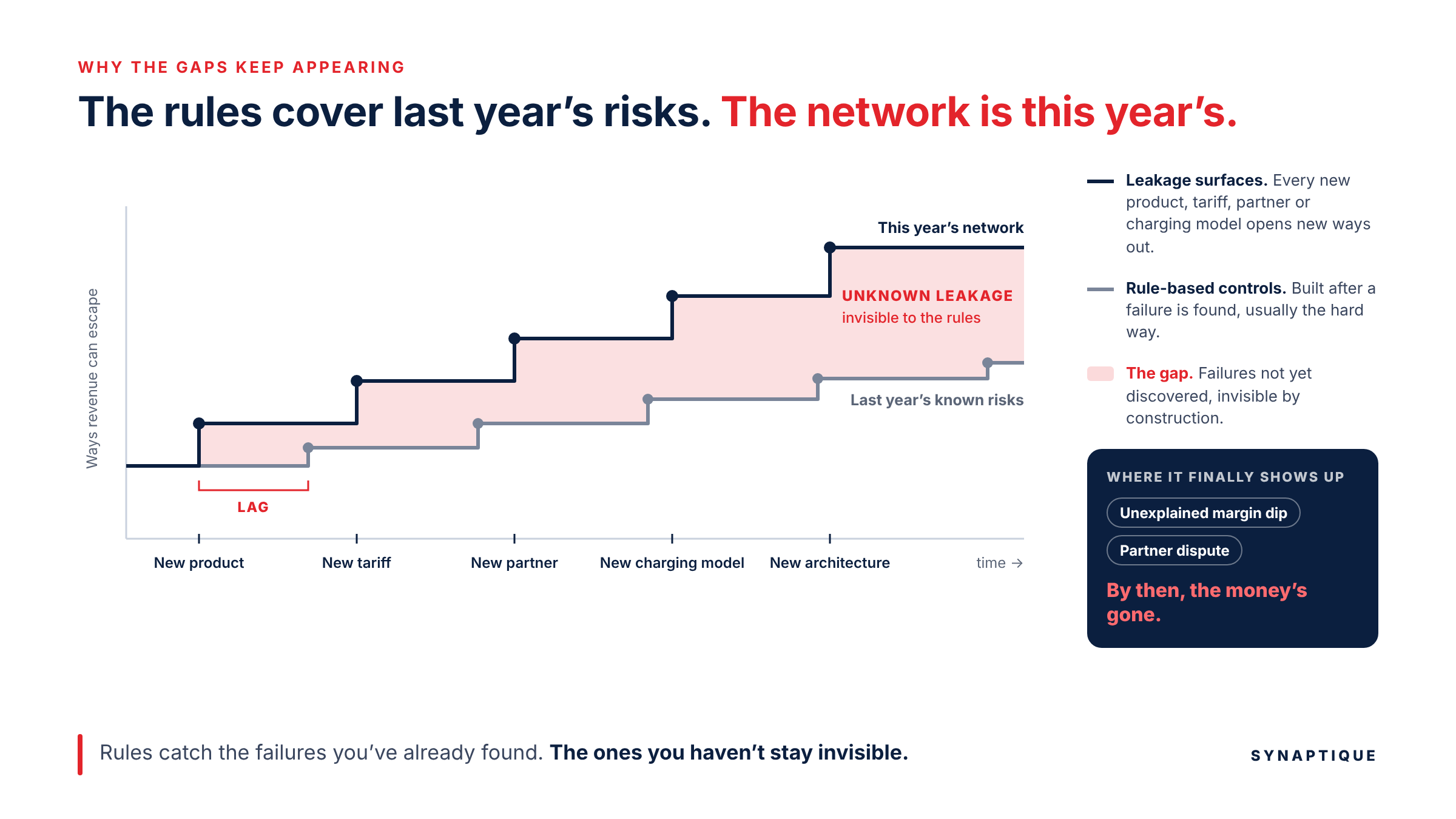
Traditional revenue assurance is rule-based. You identify a known way of revenue leaks, you build a check for it, you monitor the check. It’s a reasonable model, and for the failure points it covers, it works.
The problem is that the network it’s watching keeps changing underneath it. Every new product is a new leakage surface. Every new tariff, every new partner, every new charging model, every new piece of architecture bolted onto an already-complex estate, each one creates ways for revenue to escape that your existing controls were never designed to see. The controls are a snapshot of last year’s known risks. The network is this year’s.
So there’s a permanent lag. The rules cover the failure modes you’ve already discovered, usually the hard way. The failures you haven’t discovered yet are, by construction, invisible to a rule-based system, and they stay invisible until they grow large enough to show up somewhere else, like an unexplained margin dip or a partner dispute. By then the money’s gone.
The honest shape of the problem
Here’s what makes this genuinely difficult, rather than just a matter of trying harder. You cannot write a control for an unknown unknown. If you knew the specific way revenue was leaking, you’d already have built the check. The whole category of risk here is “the leakage I don’t yet know to look for”, and no amount of adding more rules solves it, because every new rule is still just another known-failure check.
Operators feel this as a quiet unease rather than a specific alarm. The numbers roughly reconcile. The controls are green. And yet the margin isn’t quite what the commercial team modelled, and nobody can say precisely why. That gap between “all our checks pass” and “the money still isn’t all here” is the signature of leakage happening outside the controls.
This is not an argument against rule-based RA. Keep it, it’s catching real money. It’s an argument that rule-based RA has a ceiling, and the ceiling is everything you haven’t thought to check for.
A different question
Getting above that ceiling needs a change in the question you ask. Rule-based assurance asks: is this specific thing wrong? It needs you to name the failure in advance. The approach that catches the unknown asks the opposite: what in this data doesn’t look the way it should, without anyone specifying, ahead of time, what “wrong” is supposed to look like.
In practice that means learning what normal looks like across your own history (normal for this route, this product, this partner, this time of month) and surfacing what departs from it. A new tariff quietly rating below its commercial definition. A partner feed drifting away from the network records over weeks. A product generating usage with no matching charge after a system change. None of these has a rule watching for it. All of them show up as a deviation from the baseline, because the question was never “is this the known failure” but “is this behaving like it should.”
It doesn’t replace your controls. It sits on top of them: the rules keep catching the known failures efficiently, and anomaly detection covers the space the rules can’t reach, the unknown unknowns. The two together are the point. Rules for what you know; pattern detection for what you don’t.
Where to start
Not with a platform. With a question you can answer on data you already have: of the leakage you found last year, how much did a control catch before it showed up in the margin, and how much did you discover the expensive way? That ratio is the size of your blind spot.
If you want to see what sits in it, the cheapest first move is to run anomaly detection against one revenue domain (interconnect, say, or a product family with complicated charging) on your own history, and look at what surfaces that your controls never flagged. It usually isn’t what anyone predicted. That’s the whole reason it’s worth doing.