A SIM Swap Fraud and a Lost Phone Look Identical. Here's the Difference
A customer loses their phone, buys a new SIM, and keeps their number. The same week, a fraudster social-engineers a SIM swap on someone else’s number, resets the wallet PIN, adds themselves as a beneficiary, and drains the account. Here is the uncomfortable part for a mobile money fraud team: inside the wallet platform, those two events can look almost exactly the same.
That is the problem this article is about. Not that account takeover is invisible, but that it is indistinguishable, at the moment it matters, from something completely legitimate that happens thousands of times a day. And when the fraudulent version and the innocent version produce the same signals, a system tuned to catch one will either miss it or drown in false alarms from the other.
Why the two look alike
Start with what a legitimate SIM swap actually is. People lose phones constantly. They upgrade devices, damage SIMs, switch handsets, port numbers. Every one of those is a real subscriber doing a completely ordinary thing, and every one of them produces a SIM change followed, often, by activity on the account from the new device. A wallet that treated every SIM swap as suspicious would be flagging a huge volume of its own loyal customers, declining their transactions, and training them to resent it. So it doesn’t, and it can’t.
Now look at the fraudulent version. A fraudster gains control of the number through a SIM swap, which is the same event the network sees for the customer who lost their phone. They reset the credential, which the platform sees as a password or PIN reset, the same event it sees when a real customer forgets theirs. They add a beneficiary, which real customers do all the time. They make a transfer, which is the entire purpose of a wallet. Every individual step in an account takeover is, on its own, a thing legitimate users do every single day.
This is why the fraud is so hard to stop at the point of the transaction. The wallet is not failing to see the events. It is seeing them, and each one looks normal, because each one is normal in isolation. There is no single moment in the sequence where the platform can point and say “that is the fraudulent step,” because no step is fraudulent on its own. The fraud is not in any of the events. It is in their arrangement.
The signal is the sequence, not the event
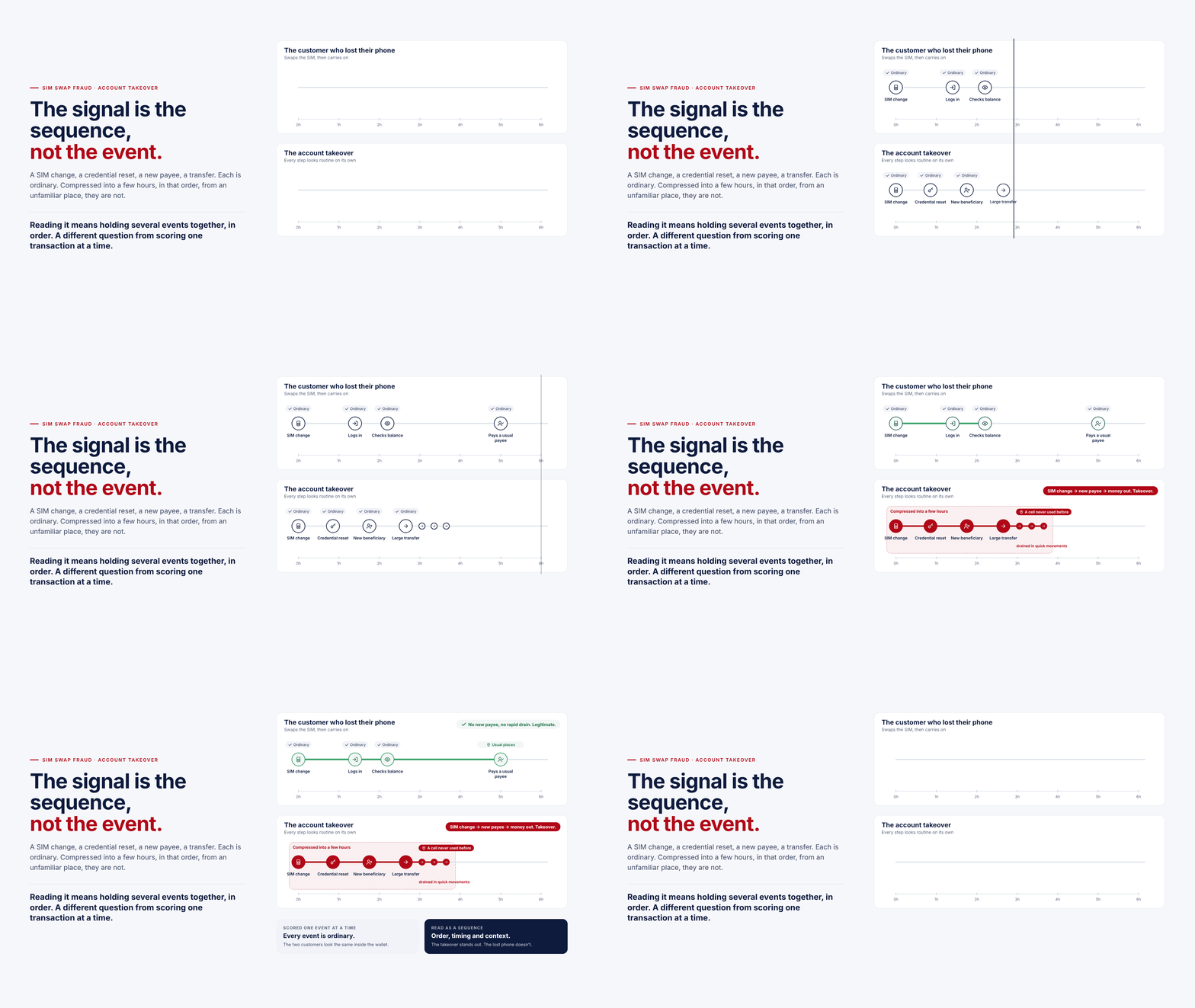
What separates the takeover from the lost phone is not any one action. It is the order, the timing, and the context around the actions taken together.
Consider the fraudulent chain as a whole. A SIM changes. Within hours, not weeks, a credential reset follows. Shortly after that, a new beneficiary is added, one the account has never paid before. Then a transfer goes out, often for an unusually large amount, or drained in several quick movements, frequently from a location or a cell the real subscriber has never transacted from. Each event is ordinary. The sequence, compressed into a few hours, moving from SIM change to new payee to money leaving, from an unfamiliar place, is not ordinary at all. That specific pattern is what a legitimate SIM swap almost never produces.
The customer who lost their phone swaps the SIM and then, usually, just carries on. They log in, they check their balance, they pay the people they always pay, from the places they always are. There is no sudden new beneficiary followed by a rapid drain. The absence of that tell-tale sequence is exactly what marks them as legitimate. The presence of it is exactly what marks the fraudster.
So the distinguishing evidence exists, and it is strong. But it is not a property of any event the wallet can score in isolation. It is a property of the relationship between several events, across time, and reading it requires holding those events together and in order. That is a different kind of question from the one a transaction monitoring system is built to ask.
Why transaction rules alone can’t separate them
A wallet platform’s fraud rules work on transaction data, and they work well on the things transaction data contains: velocity, amount, beneficiary, frequency. The trouble is that the signal that separates a takeover from a lost phone is only partly in the transaction data. The transfer itself is there. But the SIM change that should make that transfer suspicious is not a transaction. It is a network event, sitting in a different system, and the PIN reset may sit in a third.
So the wallet is trying to tell two identical-looking transfers apart while holding only one of the two facts that distinguish them. It can see that a large transfer went to a new beneficiary. What it often cannot see, in the same place and at the same time, is that this account’s SIM changed six hours ago. Without that, the transfer looks like what it resembles most: a normal customer moving money. The platform can tighten its transaction rules as far as it likes and it will not fix this, because the missing piece is not a better threshold on the transaction. It is an event that is not in the transaction stream at all.
The result is the bind every mobile money fraud team knows. Treat every large transfer after a profile change as suspect, and you bury your analysts in false positives from customers who genuinely lost their phones. Treat none of them as suspect, and the takeovers walk straight through. There is no setting on the transaction rules that resolves this, because the information that would resolve it is not on the dial they are turning.
Why this is getting harder, not easier
This is not a static problem. Two things are making it sharper.
The first is that SIM swap fraud is increasingly organised and increasingly fast. The window between the SIM change and the cash-out has compressed, because fraudsters know that speed beats detection. The faster the chain runs, the less time any human review has to catch it, and the more it matters that the correlation happens automatically and in near real time rather than in a report the next morning.
The second is that the two systems holding the two halves of the evidence, the telecom side with the SIM and device events, and the wallet side with the transactions, are usually run by different teams, sometimes different parts of the business entirely, with data kept on different schedules. The SIM-swap event the fraud team needs may be retained on the network side for a short operational window and gone by the time the suspicious transaction is investigated days later. The evidence that would have distinguished the fraud from the lost phone existed, and then expired, in a system the fraud team doesn’t own.
The question worth asking your own operation
Here is the question that tells a mobile money fraud team whether this gap is open for them right now:
Take a set of your confirmed account-takeover cases from last quarter. For how many of them was there a SIM change or a device change in the hours or days before the fraudulent transfer, a signal that existed somewhere in your systems at the time, but that nobody connected to the transaction until after the money was gone?
If you can run that check easily, you already correlate the two sides, and you are in a strong position. If you cannot run it easily, because the SIM events and the wallet events live in separate systems that were never joined, then that difficulty is the whole problem in miniature. The evidence to tell a takeover from a lost phone is sitting in your organisation. It is just not sitting in the same place, at the same time, as the transaction it would have explained. Closing that gap is a specific and solvable piece of work, and it is where the companion to this piece picks up.
What this changes about catching it
The temptation, faced with account takeover, is to look for a cleverer way to judge the suspicious transfer. A sharper rule, a tighter threshold, a better model of what a risky transaction looks like. But the transfer is not where the answer is, because the fraudulent transfer and the legitimate one are the same transfer. No amount of scrutiny applied to the transaction alone will separate them, because the thing that separates them is not in the transaction.
The answer is to stop trying to tell them apart at the moment of the transfer and start reading the sequence that led to it. A SIM change, then a reset, then a new beneficiary, then money leaving from an unfamiliar place, all inside a few hours, is a pattern a legitimate lost phone almost never produces. Seen as a sequence, the takeover is obvious. Seen as a single transaction, it is invisible. The entire difference is whether you are looking at the events together and in order, or one at a time.
That shift, from scoring the transaction to reading the sequence, is not a tuning change. It is a change in what the fraud system is allowed to see, and it depends on bringing the network-side events and the wallet-side events into the same place, at the same time, in the right order. Do that, and the question stops being “is this transfer suspicious,” which has no reliable answer, and becomes “did this account just go through the sequence that precedes a takeover,” which has a very reliable one. The fraud was never truly hidden. It was only ever split across a line nobody had drawn together.