Reconciling Network, Mediation, Charging and Billing, Continuously
Revenue that leaks between the network and the bill is rarely dramatic. It doesn’t announce itself with a failure or a complaint. It accumulates quietly, a few records here, a mis-rated event there, until it surfaces as a margin that’s softer than it should be and nobody can say exactly why. The way you close that kind of gap is not with a bigger annual audit. It’s with continuous reconciliation across the whole chain: network, mediation, charging and billing, checked against each other, all the time.
This piece is about what that actually means in practice, and it ends with a 25 point self-assessment you can run against your own operation today.
Why reconciliation has to be continuous
A usage event has to survive a long journey to become revenue. The network element generates a record. Mediation collects and formats it. Rating and charging price it. Billing turns it into an invoice or a prepaid decrement. Only after it clears every stage does it count as money.
The gap opens in the handoffs between those stages, which is exactly where no single system is looking. Billing reconciles perfectly against what it received, with no knowledge of what it should have received. Mediation drops a malformed record silently. Rating faithfully applies the wrong price to a mis-classified event. Each system is internally consistent, and the leak lives only in the relationship between them.
That is why a point-in-time audit struggles here. By the time the annual review runs, the records have aged out, the period is closed, and a gap that started with a network change six months ago has been running, unrecoverable, ever since. Continuous reconciliation flips that. A new leak introduced by a new gateway, a new tariff or a new partner surfaces in the week it starts, while you can still fix it and while the revenue is still recoverable inside your contractual windows.
The difference between the two approaches is not analytical sophistication. It’s timing, and timing is the whole game.
What continuous reconciliation requires
Reconciliation needs both sides of a comparison in one place, at the same granularity, for long enough to look. That sounds obvious, and it’s precisely what a traditional setup makes hard, because the network records and the billing records live in separate systems with separate retention windows. The network side ages out after weeks. The billing side is kept for years. Comparing them at the event level, after the fact, is difficult exactly when you most need to.
Continuous reconciliation asks for three things. It needs the network records and the billing records held together, queryable at the event level rather than only in aggregate, because an aggregate daily count hides a steady few percent loss on one record type inside a total that looks about right. It needs enough history retained that you can investigate a gap that has been running for months, not only catch it in the moment. And it needs the checks to run continuously rather than on an annual schedule, so a new failure mode shows up while it still matters.
Put plainly: you need to be able to answer, for any period and any service, how many billable events the network generated and how many reached a bill. Not estimated. Measured, end to end, at the record level.
A self-assessment you can run this week
The fastest way to find out whether these gaps are open in your network is not to commission a study. It’s to ask your own team a series of specific questions and count the ones they cannot answer with confidence. That count is a better indicator of exposure than any benchmark anyone could quote you, because it tells you where you are not currently looking.
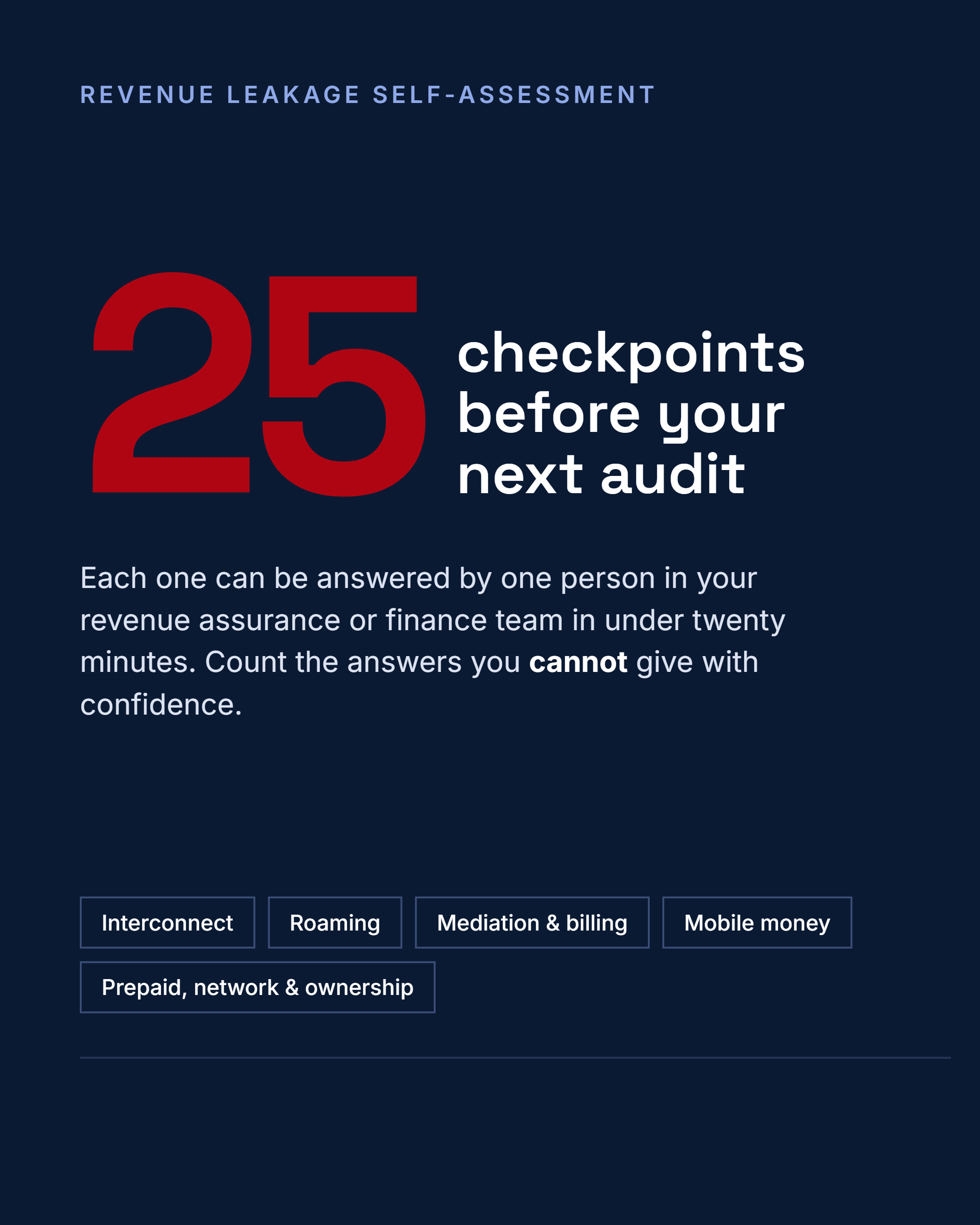
Here are 25 checkpoints, grouped across the places leakage actually hides. Read them as a diagnostic, not a quiz. The uncomfortable ones are the valuable ones.
Interconnect
- Are inbound international minutes reconciled against partner statements every billing cycle, not only when a dispute is raised?
- Do you compare your own CDR counts against each partner’s declared volumes, route by route and period by period?
- Are transit and refile routes recorded separately from direct routes?
- When a partner statement differs by less than a tolerance threshold, is the difference written off automatically, and who approved that threshold?
- Could you produce the CDR level evidence behind a disputed interconnect invoice from 14 months ago within one working day?
Roaming
6. Are TAP files checked for records rejected on arrival, and is the rejected volume tracked as revenue at risk rather than a technical error?
7. Do you reconcile the charges partners bill you against your own record of where your subscribers actually were?
8. Are TAP records that arrive after the billing cycle closes still captured and rated, or do they fall outside the revenue count?
9. Is there a check that every roaming call a partner rated corresponds to a subscriber registered on their network at that time?
10. Do you measure the gap between roaming traffic visible at the network layer and roaming traffic that reached an invoice?
Mediation and billing
11. Is the record count leaving mediation compared with the count entering it, per feed, per day?
12. Are records dropped by mediation for schema or format errors logged, counted and reviewed, or discarded silently?
13. Can you demonstrate that every tariff configured in billing matches the tariff that was commercially approved?
14. Are zero rated and free of charge record types reviewed periodically to confirm they should still be free?
15. When a new plan launches, is a reconciliation check in place before the first billing cycle closes, or does verification wait for a complaint?
Mobile money
16. Are agent float movements reconciled against transaction records daily?
17. Do you monitor for structuring, meaning repeated amounts just below a fee, limit or reporting threshold from the same party?
18. Are SIM swap events correlated with mobile money activity in the following 24 hours?
19. Is there a check on transactions where sending and receiving accounts share a device or handset identifier?
20. Could you identify an agent whose commission earnings rise while their active customer count stays flat?
Prepaid, network and ownership
21. Is prepaid balance depletion reconciled against rated usage, by subscriber cohort rather than in aggregate?
22. Are calls that complete at the network layer but generate no CDR measured, and quantified in minutes and in currency?
23. Do you know your current end to end volume gap between switch records, mediation output and billing, as a percentage?
24. Is one named person accountable for revenue leakage, with a figure they report every month?
25. When leakage is found and fixed, is the recovered amount recorded, so the programme can show what it returned?
Reading your score
Count the questions you could not answer with confidence.
If it’s zero to five, your reconciliation coverage is better than most operators we assess, and the remaining exposure is probably in mobile money or late arriving records. If it’s six to twelve, you’re in the typical range, and that range is typically expensive: the gaps are usually in mediation loss and roaming, both of which are measurable within a fortnight. If it’s thirteen or more, the exposure cannot be estimated from the outside, and probably not from inside either. The place to start is checkpoint 23, because the end to end volume gap tells you where to look next.
Whatever the number, the point of the exercise is the same. The questions you cannot answer are not gaps in the checklist. They’re gaps in your visibility, and a gap in visibility is where leakage runs the longest.
Get the full checklist as a PDF
We’ve put all 25 checkpoints into a printable two page self-assessment, with the scoring guide, laid out so you can take it straight into your next revenue assurance review and tick it as a team. It’s free, and there’s nothing to sit through to get it.
[Download the Revenue Leakage Self-Assessment (PDF)]
If, once you’ve scored it, the questions you couldn’t answer are worth turning into real numbers, that’s the work we do: a scoped reconciliation on your own data that quantifies the gaps by stream and shows which are recoverable inside your contractual windows.