How Banks Can Cut False Positives: Behavioural Baselining on Deep History
False positives are not a sign of a mis-set threshold. They are a sign of missing context: an engine judging transactions without knowing the customers they belong to. The fix is to stop asking “is this transaction over the line” and start asking “is this transaction normal for this customer.”
That reframing is easy to say. This piece is about what it actually takes to build, because the reason banks have lived with the blunt dial for so long is not that the better question never occurred to them. It is that answering it, for every transaction, in real time, has been genuinely hard. Two things make it hard, and both have become tractable in a way they were not a few years ago.
What behavioural baselining actually is
A behavioural baseline is a model of what is normal for one specific customer, built from that customer’s own history. Not a global rule that treats everyone the same, but an individual picture: this person’s usual transaction sizes, their usual times and places, the beneficiaries they usually pay, the rhythm of their pay cycle, the ordinary irregularity of a real life. Against that picture, a transaction is judged not by whether it crosses a universal line, but by how far it departs from this customer’s established pattern.
The payoff is the thing the false-positives piece pointed at. A large transfer is unremarkable for a customer who makes large transfers every month, so it does not fire. A foreign transaction is routine for someone who travels and a genuine flag for someone who never does, and the baseline knows the difference. The retiree’s fridge, which a flat threshold flags because it is large in the abstract, is clearly in character once you compare it to the retiree’s own history, so the alert never fires and the analyst never wastes an hour on it. At the same time, a payment that sits comfortably under a global threshold but is glaringly out of character for that specific person does fire, which is exactly the fraud a flat rule waves through.
Behavioural baselining cuts false positives and catches more real fraud at the same time, because it is answering the right question. But it has two hard requirements, and they are where the engineering lives.
The first requirement: long history, and enough of it
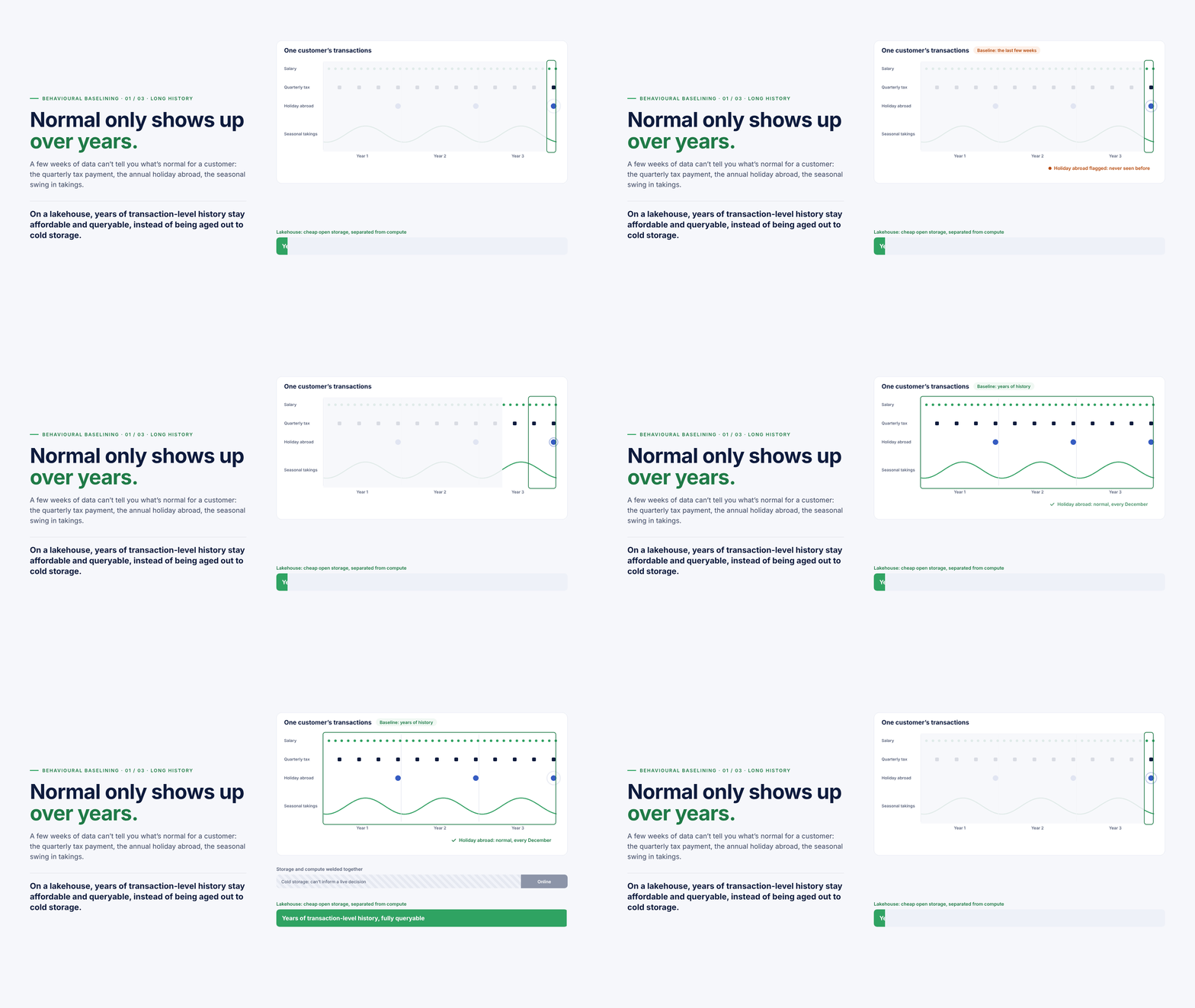
A baseline is only as good as the history it is built from. A few weeks of data cannot tell you what is normal for a customer, because normal includes things that only appear over time: the quarterly tax payment, the annual holiday abroad, the seasonal swing in a small business’s takings, the salary that arrives on a particular day. Judge a transaction against a short history and the baseline itself is naive, flagging as anomalous the perfectly ordinary events it has simply never seen before.
So behavioural monitoring needs deep history. Years of it, ideally, held at the level of the individual transaction, so the model of each customer is built on their genuine long-run pattern rather than a recent snapshot. This is the first place traditional systems struggle. Keeping years of transaction-level history online, in a system fast enough to query during authorisation, has historically been expensive enough that banks either kept less history than they needed or moved it to cold storage where it could not inform a live decision. A baseline built on what was cheap to keep rather than what was needed is a weak baseline.
This is where the economics of a data lakehouse change the calculation. Because storage is cheap, open object storage, separated from compute, keeping years of transaction-level history fully queryable is affordable in a way it was not when storage and compute were welded together and you paid for both at all times. The deep history that behavioural baselining depends on stops being a cost you cannot justify and becomes the normal state of the system. On the Synaptique platform, that history lands in Apache Iceberg tables on storage the institution controls, ingested continuously through Apache Kafka and Apache NiFi, and it stays queryable rather than being aged out.
The second requirement: querying data where it lives
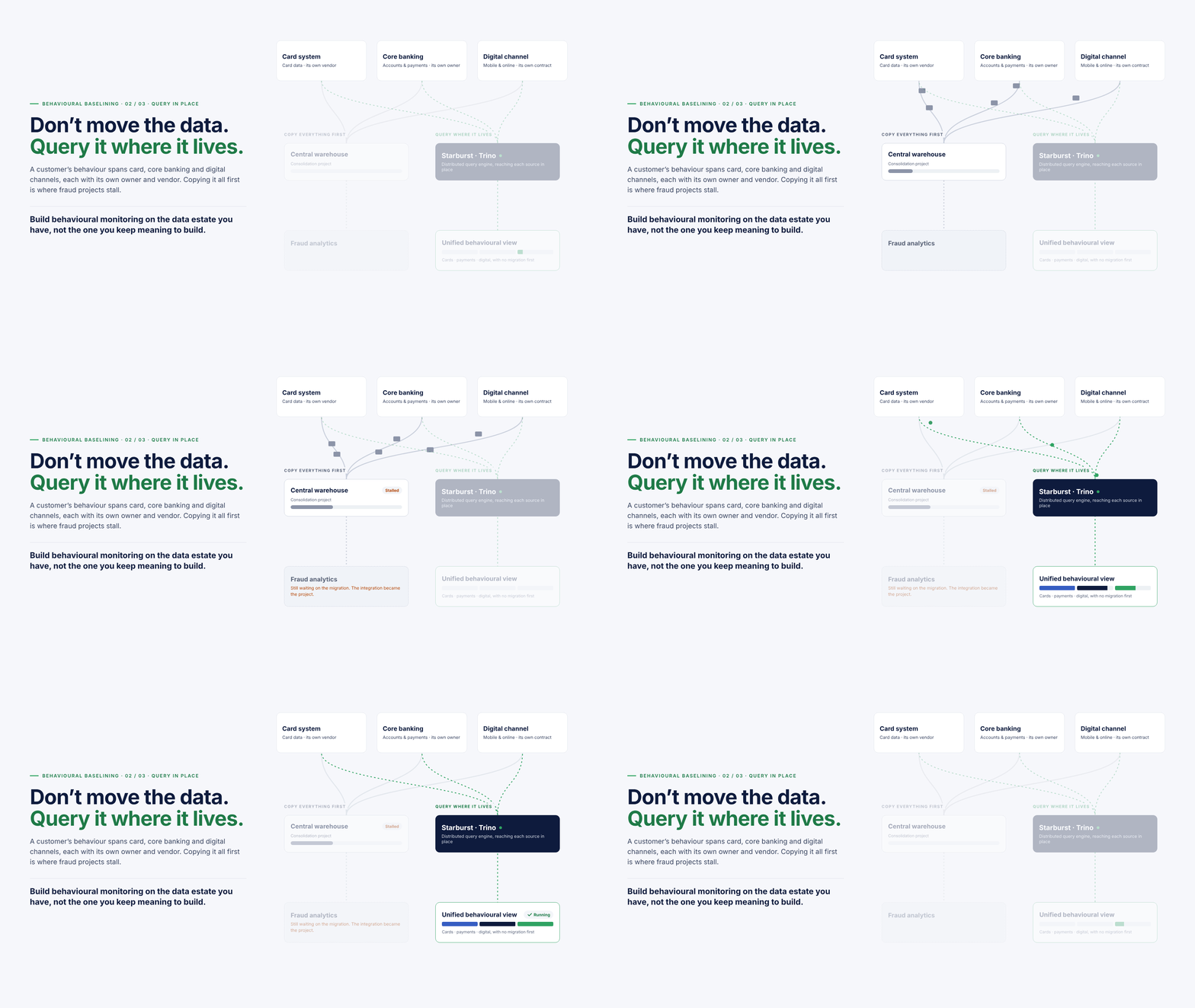
The second difficulty is less obvious and, in a bank, often the one that actually kills these projects. A customer’s behavioural picture does not live in one system. The card data is in one place, the account and payment data in another, the mobile or digital channel somewhere else again, each with its own owner, its own vendor contract, and a very good reason not to be disturbed. Building a real behavioural baseline means drawing on all of them, because a customer’s normal spans all of them.
The traditional approach is to copy everything into one central store first, a consolidation project that has to happen before any of the fraud work can begin. These projects are slow, expensive, and politically fraught, and a great many fraud initiatives stall at exactly this step, never reaching the analytics they were commissioned to deliver. The data integration becomes the project, and the project runs out of road.
The alternative is to query the data where it already sits, without moving it first. A distributed query engine can reach across the card system, the core banking data, and the digital channel in place, and return a unified view for analysis, without a consolidation programme as a precondition. On the Synaptique platform this is Starburst and Trino doing that work: the behavioural picture is assembled by querying across the sources that hold a customer’s activity, rather than by first copying them all into one warehouse. The practical effect is that behavioural monitoring can be built on the data estate a bank actually has, rather than waiting on the one it keeps meaning to build.
How it comes together
Put the two together and the capability is straightforward to describe, even though each half was hard to deliver alone. Deep transaction history, held affordably and kept queryable, gives you a baseline built on each customer’s genuine long-run behaviour. A distributed query layer gives you that behaviour across all the systems it actually lives in, without a migration first. On top of that sits the scoring: every transaction judged against the individual’s own established pattern, in the flow of authorisation, fast enough to act on.
What a bank gets from it is the outcome the false-positives piece set out. Fewer alerts, because the ordinary-in-context transactions that a flat threshold flags simply do not fire. Better alerts, because the ones that do fire are genuinely out of character for that customer, which means analysts spend their time on signal rather than noise. And more real fraud caught, because the organised and the subtle, the payment that sits under every global threshold but is wrong for this person, becomes visible when you are comparing against the individual rather than the crowd.
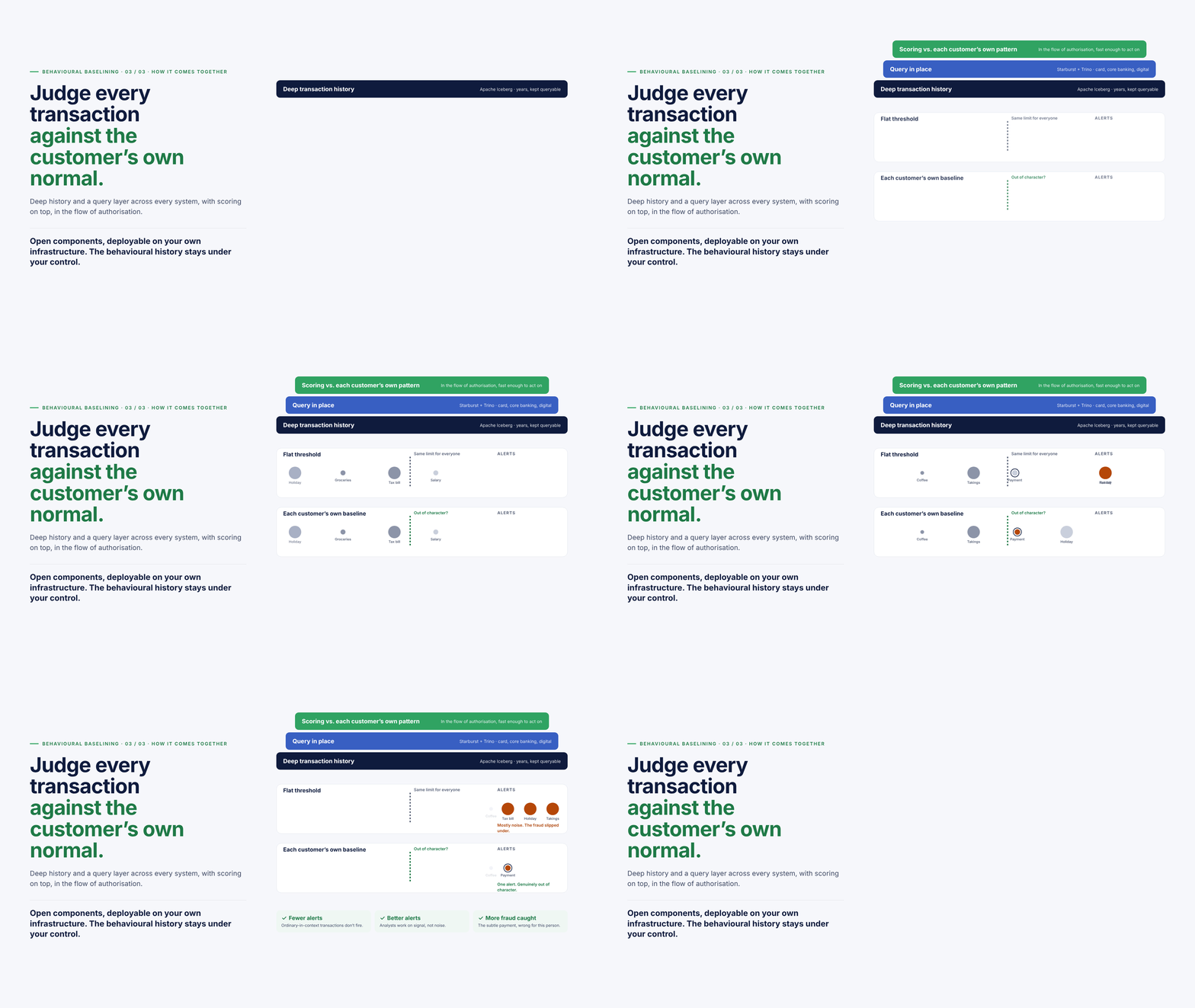
On the Synaptique platform the whole thing runs on open components, deployable on the institution’s own infrastructure, which matters for a bank: the behavioural history is among the most sensitive data you hold, and keeping it under your own control rather than in a vendor’s black box is usually a requirement, not a preference.
What it does not do, honestly
Behavioural baselining is not a model you switch on and leave. A baseline drifts, because customers’ genuine behaviour changes. People move, change jobs, start travelling, grow a business. If the model does not relearn, it starts flagging the new normal as anomalous, and you are back to false positives by a different route. This needs maintenance and retraining, and any vendor who tells you otherwise is selling.
It does not make the single-transaction rules obsolete either. The crude, obvious fraud is still caught most efficiently by a simple rule, and those should stay. Behavioural monitoring sits on top, for the context-dependent cases a flat rule cannot judge. The two together are the system, not one in place of the other.
And it produces investigations, not verdicts. A behavioural anomaly is a strong signal that deserves a human’s attention, not an automatic decline. What changes is that the human’s attention is now spent on genuinely suspicious departures from a customer’s own pattern, rather than on a queue full of large-but-normal transactions that were never fraud at all.
Where to start
Not with a platform migration, and not by ripping out the engine you have. The honest first step is to take a defined slice of your own history, build behavioural baselines for a set of customers across the systems their activity lives in, and compare what that approach would have flagged against what your current rules actually flagged over the same period. The question it answers is concrete: how many of last quarter’s false positives would a behavioural model have spared, and how many genuine anomalies would it have caught that the thresholds missed?
That is a bounded exercise on data you already hold, and it ends on a number you can take to a decision. Synaptique runs exactly that as a scoped engagement: behavioural baselining on your own history, querying across your own systems, measured against your current engine’s results. If you would like to see what it would change for your false-positive rate and your detection at the same time, that is the conversation to have.