How to Detect SIM Swap Account Takeover Before the Money Leaves
In our blog post “SIM Swap to Account Takeover: Identical Inside the Wallet,” the argument was that a fraudulent SIM swap and a legitimate one look the same inside a wallet, and that the only thing separating them is the sequence: a SIM change, then a credential reset, then a new beneficiary, then a transfer, compressed into a few hours, often from an unfamiliar place. The fraud is in the arrangement of ordinary events, not in any one of them.
That is a clear diagnosis. This article walks through what it actually takes to detect that sequence in practice: which events you need, where they come from, how you join them, and what the detection looks like once they are together. It is a use case rather than an argument, because the point of “the sequence is the signal” only becomes real when you can see it operating on live data.
The events that make up the sequence
Start by naming the signals, because they come from two different worlds and that is the heart of the challenge.
From the telecom side come the identity and device events. The SIM change itself, logged when a number is reassigned to a new SIM. The IMEI change, which tells you the account is now being used from a different physical handset. The location or cell the subscriber is transacting from, which tells you whether this is a place they have ever been active before. These are network events. They live in provisioning systems, in signalling, in the HLR, in device registers. The wallet does not generate them and often does not see them.
From the wallet side come the account and money events. The credential reset, when a PIN or password is changed. The beneficiary addition, when a new payee is registered. The transfer itself, with its amount and its timing. These are transaction-platform events, and the wallet sees them clearly.
The takeover sequence is a specific ordering of events drawn from both lists: SIM or IMEI change, then reset, then new beneficiary, then transfer, within a tight window, from an unfamiliar location. No single system holds all of those events. The telecom side has the first and the device and location context. The wallet side has the reset, the beneficiary and the transfer. To see the sequence, you have to hold both sides together, on one timeline.
Step one: bring both event streams into one place
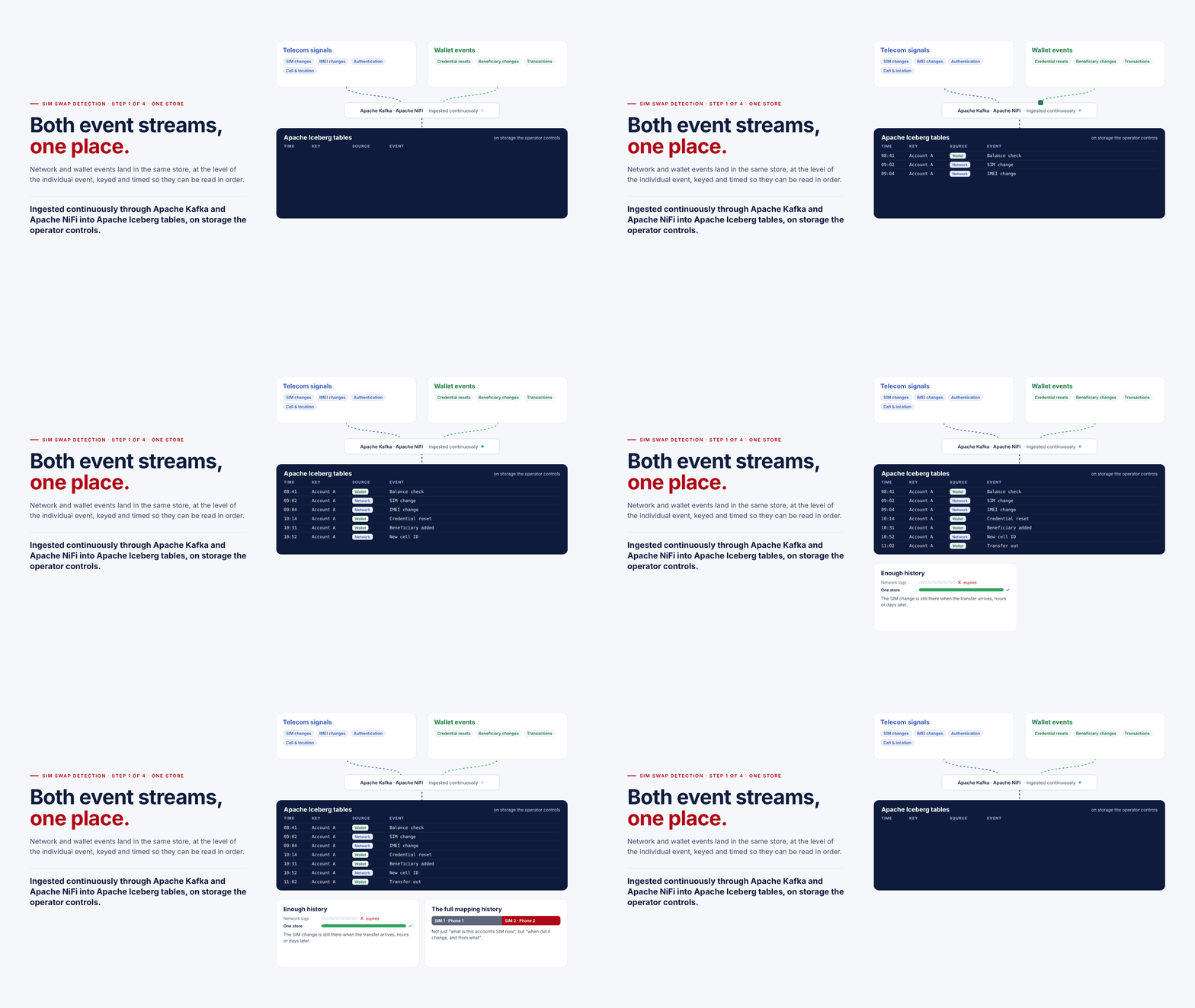
The first requirement is unglamorous and decisive: the network events and the wallet events have to land in the same store, at the event level, keyed and timed so they can be read in order.
On the Synaptique platform this is the ingestion and storage layer. The telecom signals, SIM changes, IMEI changes, authentication events, cell and location, and the wallet events, resets, beneficiary changes, transactions, are ingested continuously through Apache Kafka and Apache NiFi and written into Apache Iceberg tables on storage the operator controls. Both streams, one store, kept at the level of the individual event rather than summarised.
Two properties of that store matter specifically for this use case. The first is that it keeps enough history that a SIM-change event is still present when the suspicious transfer arrives hours or days later, which is exactly the retention gap that causes the evidence to expire on the network side before anyone connects it. The second is that it holds a full timeline of the relationship between SIM, device and account, so you can answer not just “what is this account’s SIM now” but “when did it change, and from what.” That history of the mapping is itself the data the detection depends on.
Step two: resolve identity and time across the two worlds
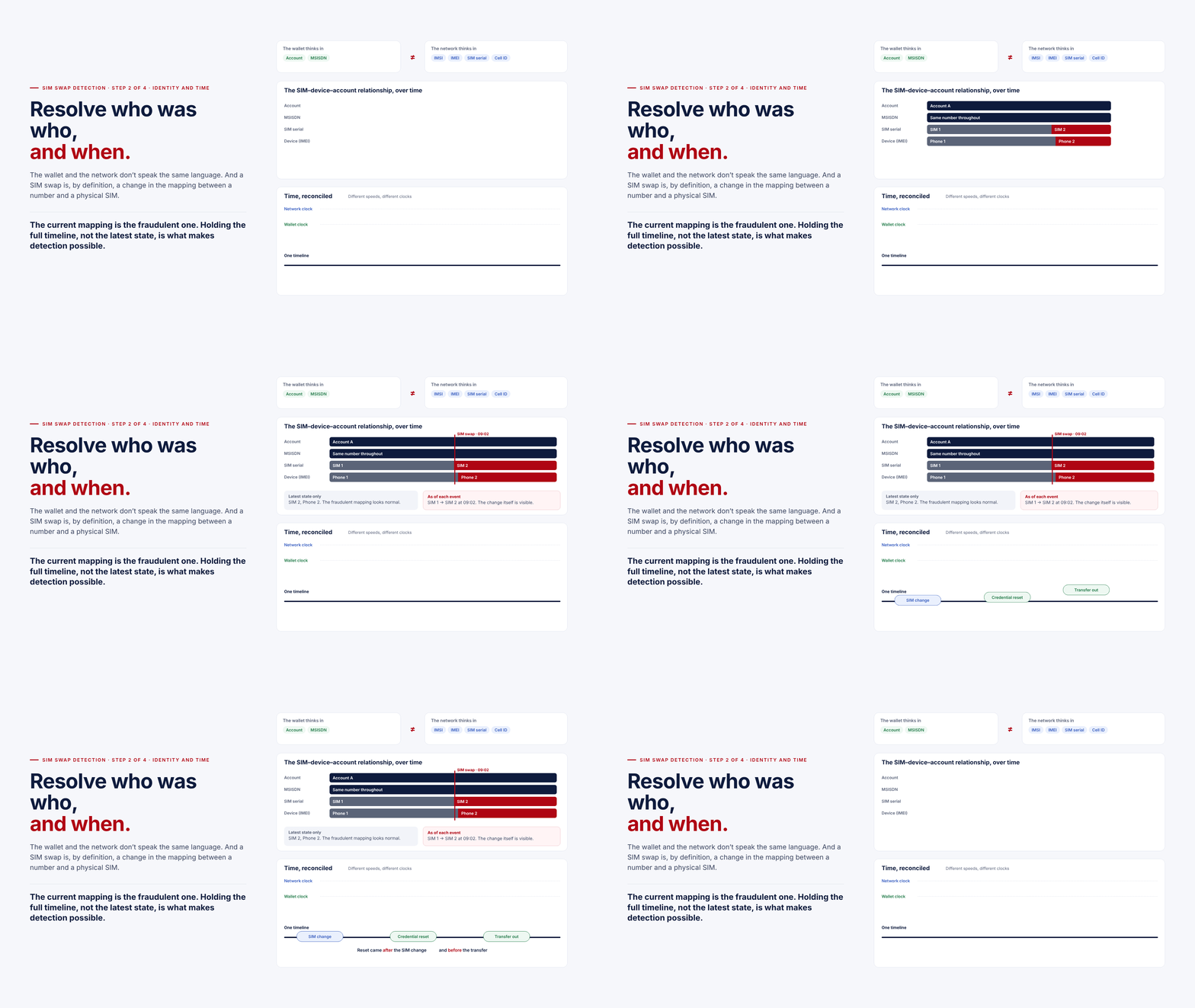
Having both streams in one store is necessary but not sufficient, because the two worlds do not speak the same language. The wallet thinks in accounts and MSISDNs. The network thinks in IMSIs, IMEIs, SIM serials and cell IDs. To line up “this transfer” with “this SIM change,” you have to resolve which network identity corresponds to which wallet account, at the moment each event happened.
That last clause is the subtle part. A SIM swap is, by definition, a change in the mapping between a number and a physical SIM. So the correlation has to be time-aware: it is not enough to know the current mapping, because the current mapping is the fraudulent one. The store has to let you ask what the state of the SIM-device-account relationship was at each point in the sequence, so you can see the change rather than only its result. This is why holding the full timeline, rather than the latest state, is the thing that makes the detection possible at all.
Time has to be reconciled too. The network events and the wallet events arrive at different speeds, timestamped by different systems. Putting them in order on a common timeline, accurately enough to say the reset came after the SIM change and before the transfer, is part of what the correlation layer does.
Step three: express the sequence as a rule
Here is the part that surprises people. Once both streams are in one store and aligned on a common timeline, the detection rule is almost embarrassingly simple. You are no longer trying to score a transaction in isolation. You are asking whether an account just moved through a known sequence.
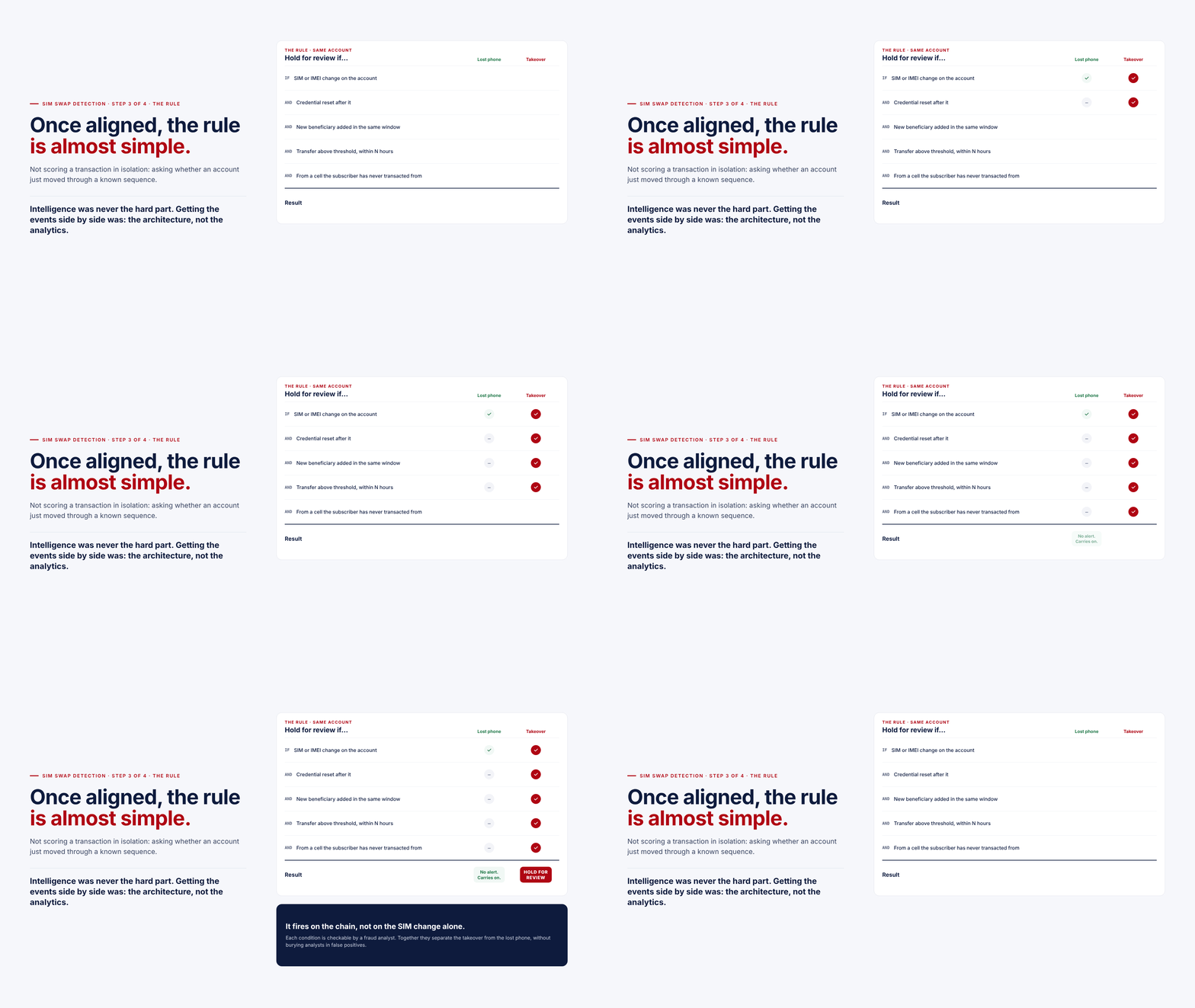
In plain terms, the rule says something like: a transfer above a threshold, occurring within N hours of a SIM or IMEI change on the same account, with a credential reset in between, to a beneficiary added in the same window, from a cell the subscriber has not transacted from before. Hold it for review.
That is a rule a fraud analyst can write and reason about. Each condition is checkable, and together they describe the takeover sequence precisely enough to separate it from the legitimate lost phone, which produces the SIM change but almost never the rapid reset-beneficiary-drain that follows. The legitimate customer changes their SIM and carries on paying the people they always pay. The fraudster produces the full chain. The rule fires on the chain, not on the SIM change alone, which is exactly why it can catch the takeover without burying analysts in false positives from every customer who lost a phone.
Intelligence, in other words, was never the hard part. Given the events side by side, the logic is simple. The hard part was getting the events side by side, which is the architecture, not the analytics.
Step four: run it fast enough to matter
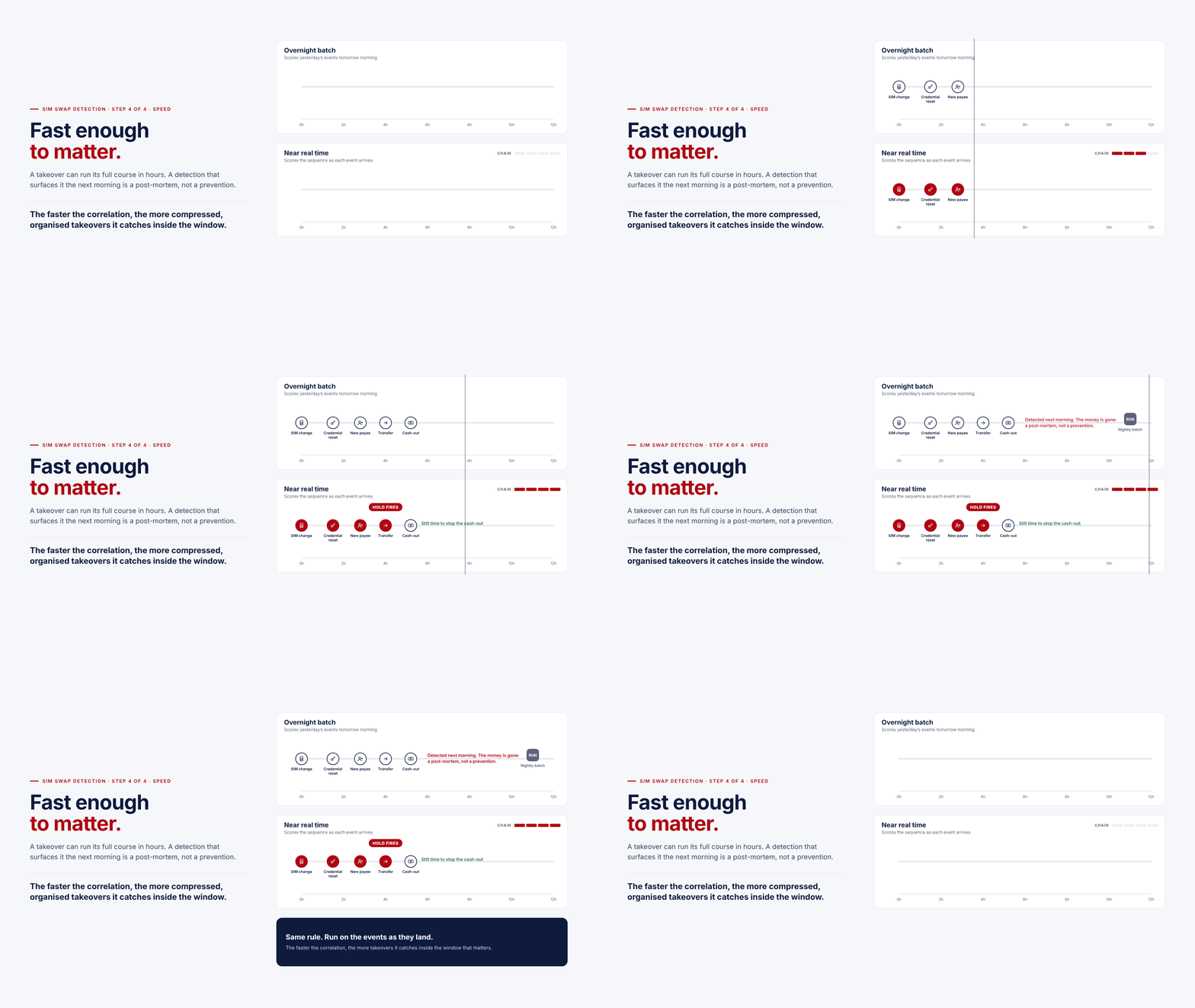
A takeover sequence can run its full course in hours. A detection that surfaces it the next morning is a post-mortem, not a prevention. So the correlation has to run in near real time, scoring the sequence as the events arrive rather than in an overnight batch.
Because the events are already streaming into the store continuously, the same sequence rule can run against them as they land, so that the moment a transfer completes the chain, the hold fires while there may still be time to stop the cash-out or claw it back. The value of the whole approach compounds with speed: the faster the correlation, the more of the compressed, organised takeovers it catches inside the window that matters.
What this does not do, honestly
Correlating the sequence reduces false positives sharply, but it does not eliminate them. A legitimate customer can occasionally produce something that resembles the pattern: they lose their phone, reset their PIN, and happen to pay a genuinely new payee soon after. The correlation makes that far rarer than a transaction-only rule would, because it requires the whole chain rather than any single step, but a human still reviews the holds. What changes is that the review queue is full of genuinely suspicious sequences instead of guesses from transaction data alone.
It also depends on cooperation between the network side and the wallet side of the business, which is an organisational matter as much as a technical one. The architecture can join the data, but someone has to agree to let it be joined. In practice that agreement is often harder to secure than the engineering, and it is worth addressing early rather than discovering late.
And it is not a replacement for the wallet’s existing transaction rules. The crude, obvious fraud is still caught efficiently by those, and they stay. Sequence correlation sits on top, for the takeover that no single-transaction rule can see, because the evidence that distinguishes it lives across two systems.
Where to start
The honest first step is to prove it on fraud you have already confirmed. Take a set of confirmed account-takeover cases from a past period. Pull the network events for those accounts for the days before each fraudulent transfer, and line them up against the wallet events. Count how many of the confirmed takeovers were preceded by a SIM or IMEI change, a reset, and a new beneficiary, in sequence, that nobody connected at the time.
That backward-looking test answers the question that matters before any live deployment: on your own data, how many of your real takeovers would a sequence rule have caught, and how early? For mobile money, the count usually comes back high enough to change the conversation about what the fraud team should be able to see.
Synaptique runs exactly that as a scoped engagement: your network events and your wallet events, joined on your own data for a defined period, with the takeovers a sequence-based rule would have caught, shown against what your current rules actually flagged. If you want to measure that gap on your own data, that is the conversation to have.