Correlating Drive-Test,Crowdsourced and Active/Passive Measurement with Operator Data
From measurement to evidence
A regulator responsible for quality of service needs evidence it can stand behind: continuous rather than occasional, broad rather than spot-sampled, and independent rather than supplied by the operator being measured.
Building it is a real engineering problem and the gap between “we need continuous evidence” and “we have it” is worth being precise about.
The goal is a single evidence base: one place where every available signal about network quality (measured, reported, and experienced) can be brought together, correlated, and queried. Not several disconnected sources that each tell part of the story, but one record that reconciles them. This piece is about what that actually takes.
The sources, and why no single one is enough
Several kinds of measurement exist, and each has a strength and a blind spot. The point isn’t to pick one, it’s to combine them.
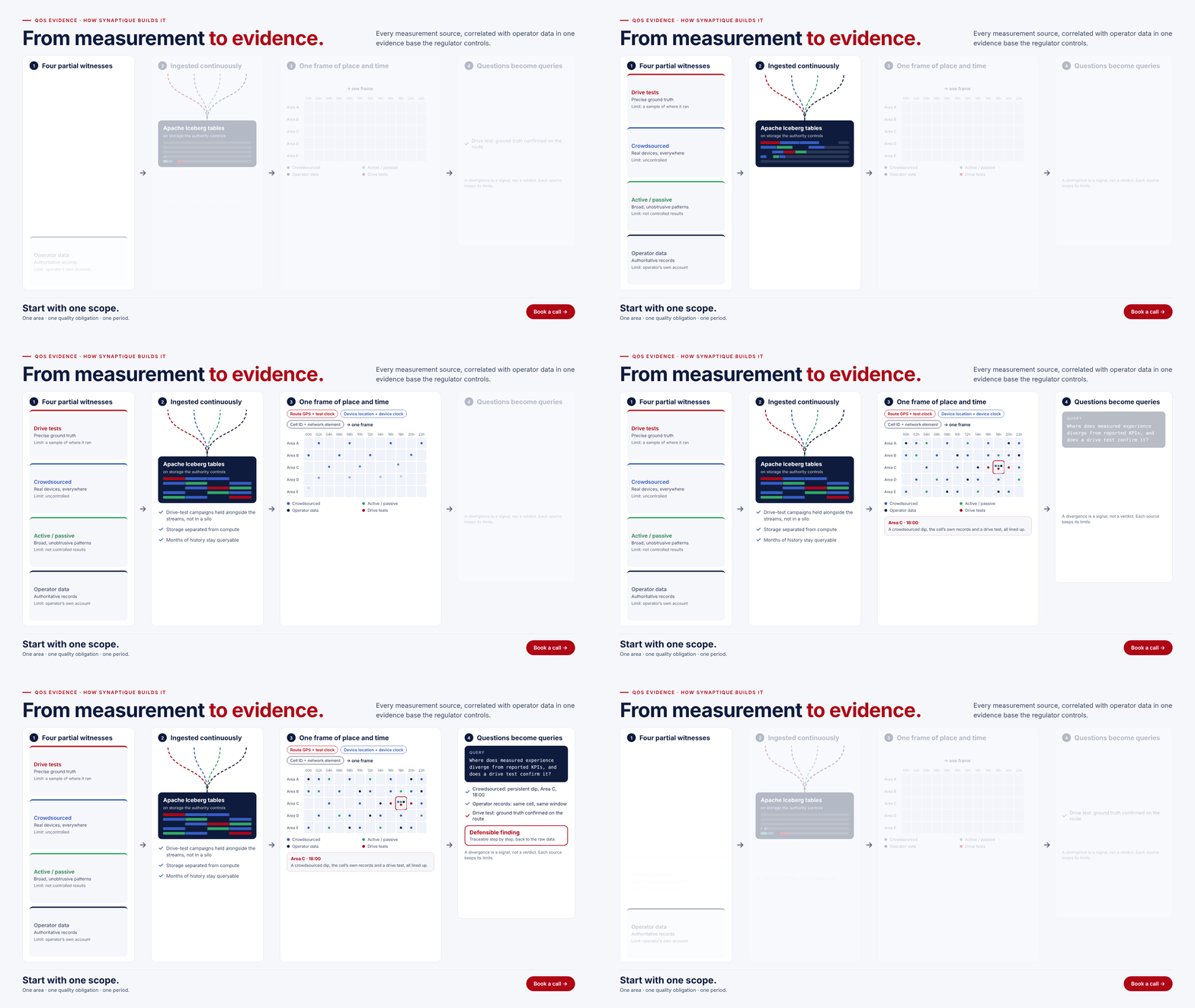
- Drive-test measurement is controlled and calibrated: trained teams, proper equipment, chosen routes. Its strength is precision and ground truth, you know exactly what was tested, how, and to what standard, which is what makes it defensible. Its limit is that it’s sampled: it speaks for where and when it ran.
- Crowdsourced measurement comes from real devices in real subscribers’ hands, across the whole territory, continuously. Its strength is coverage and realism, it’s as close to lived experience as measurement gets, in places and at times no drive test reaches. Its limit is that it’s uncontrolled: you don’t choose the device or the conditions.
- Passive network measurement (observing traffic already flowing, without injecting any) is broad and unobtrusive, and sees patterns across the network rather than controlled results.
- And then there’s operator data itself (the network records, counters and configuration) rich and authoritative about what the network did, but it is the operator’s own account.
Each of these is a partial witness. Drive test knows precisely what the network delivered on one route; crowdsourced data knows what subscribers experienced everywhere but not why; operator records know what the network did but not how it felt to use. The value is in the correlation: when a crowdsourced quality dip in a given area, at a given hour, lines up with what the operator’s own records show for that cell (and a drive test confirms the ground truth on that route) you have something no single source gives alone. An independent, continuous picture, anchored by controlled measurement and explained by the network data behind it.
Why correlating them is the hard part
Bringing these together is harder than it sounds, for the same reason correlating any two data worlds is hard: they don’t share keys, clocks, or granularity.
Drive-test results are precise and route-based, timestamped and geolocated to a high standard by the test equipment. Crowdsourced measurements are geolocated and timestamped by the device. Operator records are keyed by cell and network element. Lining up “this drive-test reading on this route,” “this subscriber’s experience here,” and “this cell’s state at that moment” means resolving location and time across sources that were never designed to be joined, each with its own precision, cadence and format. And the volume is substantial: continuous crowdsourced measurement across a territory, drive-test campaigns, and network records at CDR-like granularity, held over months, is a great deal of data to align and query.
This is why continuous QoS evidence is an architecture problem before it’s an analytics one. The analysis a regulator wants “show me where measured experience diverges from reported KPIs, and confirm it against drive-test ground truth” is straightforward once the data is together and aligned. Getting a precise drive-test reading, a broad crowdsourced signal, and the operator’s own records onto a common frame of location and time is the actual work.
How Synaptique builds it
Synaptique brings drive-test data, crowdsourced, active and passive measurement together with operator network data on a data lakehouse platform. The streams are ingested continuously and written into Apache Iceberg tables on storage the authority controls. Drive-test campaigns, which arrive as discrete high-precision datasets, are held alongside the continuous crowdsourced and network streams rather than in a separate silo so a controlled measurement on a route and the ambient subscriber experience around it can be read together. Because storage is cheap and separated from compute, the full measurement history stays queryable over long periods, which is what makes a persistent pattern (or a repeated drive-test result over successive campaigns) observable at all. Location and time are resolved into a common frame so the sources can be correlated, not merely stored side by side.
On top of that evidence base, the questions a regulator cares about become queries. Where does measured experience persistently diverge from an operator’s reported KPIs and does a drive test confirm it on the ground? Which areas show degradation that no complaint and no drive-test campaign has yet reached, visible only in the crowdsourced signal? Does a coverage claim hold up against continuous measurement, with drive-test readings as the calibrated anchor? Each answer traces back to the underlying data, step by step which matters, because a QoS finding is only useful to a regulator if it survives an operator’s challenge, and a finding anchored by controlled drive-test measurement is among the hardest to contest.
Two properties make it usable for an authority specifically. The data sits inside the regulator’s own infrastructure, under its control. And the path from raw measurement to conclusion is inspectable, so a finding whether it rests on a drive test, a crowdsourced pattern, or the correlation of both with network records, can be shown and defended rather than asserted.
What it doesn’t do
Correlating these sources doesn’t remove the need for judgement. A divergence between reported KPIs and measured experience is a signal, not a verdict, it can reflect a genuine quality problem, or a difference in what each source measures and how. A drive test is often precisely what resolves that ambiguity, by establishing ground truth on the route in question; but someone still has to decide which measurement answers which question.
It doesn’t make any single source more than it is. Crowdsourced data stays uncontrolled; operator data stays the operator’s own account; and a drive test, however precise, stays a sample of where it ran. Correlation reduces the blind spots by combining complementary witnesses, it doesn’t turn any one of them into an omniscient one. Being clear about each source’s limits is part of what makes the combined evidence credible.
And it isn’t a one-off study. The value compounds with the length of the record: a single drive-test campaign is a point, a series of them is a trend, and continuous crowdsourced measurement between campaigns is what fills the gaps the drive test can’t be everywhere to cover.
Where to start
Not with a national rollout. With one scope: a defined area or a defined quality obligation, over a defined period. Bring the available measurement together (the drive-test data for that area, the crowdsourced signal across it, and the operator’s records for the same cells and window) correlate them, and see where reported performance, measured experience and controlled ground truth agree, and where they don’t.
That bounded start answers the question that matters before any larger commitment: on your own networks, for one area, over one period, how far apart are the reported numbers, the lived experience, and the drive-test ground truth? Once a regulator has seen that all the sources on one scope, reconcile the case for a continuous, territory-wide capability makes itself.
Synaptique runs exactly that as a scoped engagement, correlating your existing drive-test data with crowdsourced and network measurement on your own networks. If you’d like to see what it reveals, that’s the conversation to have. Book a call with our team