#Independent, Continuous QoS Evidence: One Network, Three Different Stories
The problem with a snapshot
Quality of service is one of the hardest things a telecom regulator is asked to oversee, not for lack of effort or expertise, but because of what the available tools can see.
The instruments the field has relied on for years all share one trait: they capture a moment. Operators report their KPIs on a schedule. A commissioned drive test covers a set of routes on the days it runs. A consumer survey lands periodically. Each of these is valuable, and each is a photograph, accurate at the moment it was taken, in the place it was taken, and quiet about everything in between.
The trouble is that network quality isn’t a photograph. It’s a film. It varies by hour, by cell, by load, by weather, by the particular street where coverage drops. A measurement taken at 11am on a main road in the capital tells you almost nothing about 7pm in a peri-urban neighbourhood three hundred kilometres away. And between one snapshot and the next (months, usually) the regulator is blind.
Three accounts of the same network
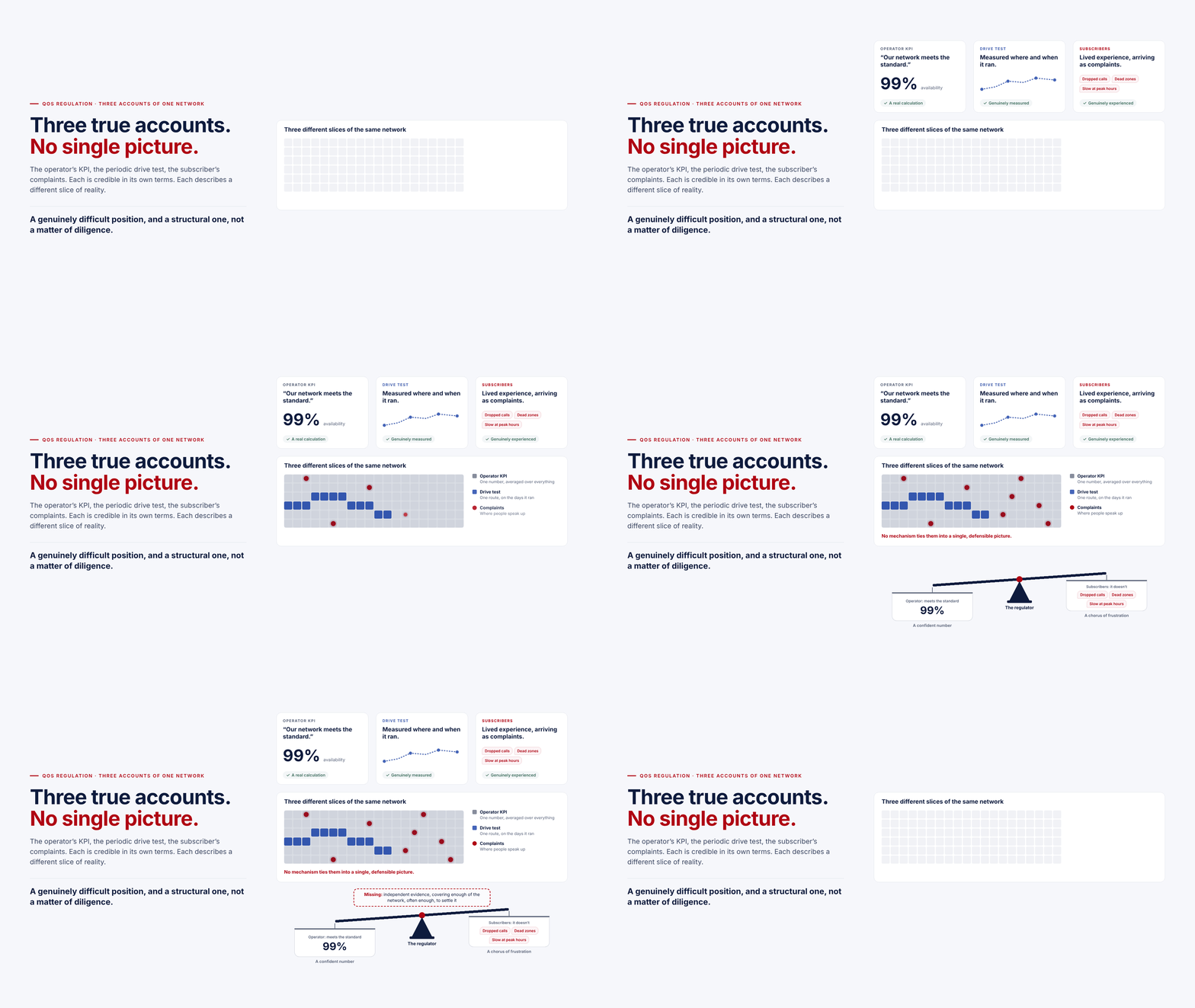
This leaves regulators holding three different accounts of one network, each credible, and no straightforward way to reconcile them.
There’s the operator’s reported KPI, “99% availability.” There’s the periodic drive test, which measures something real, but only where and when it ran. And there’s the subscriber’s lived experience, which arrives as complaints: dropped calls, dead zones, data that slows at the hours people most want it.
All three are true in their own terms. The 99% is a real calculation. The drive test genuinely measured what it measured. The complaints are genuinely what people encounter. But they describe different slices of reality, and no mechanism ties them into a single, defensible picture. So when an operator reports that its network meets the standard and subscribers report that it doesn’t, the authority is left weighing a confident number against a chorus of frustration without independent evidence covering enough of the network, often enough, to settle it. It’s a genuinely difficult position, and it’s structural, not a matter of diligence.
Why drive tests need a companion
Drive testing is one of the most valuable instruments a regulator has. A controlled, calibrated measurement, taken with proper equipment by people who know what they’re doing, gives you something crowdsourced data never can: a precise, defensible, ground-truth reading of exactly what the network delivered, where and when it was tested. For verifying a specific claim, investigating a specific area, or establishing a rigorous baseline, nothing replaces it. It stays essential.
The point isn’t that drive tests fall short. It’s that any sampled measurement (however rigorous) can only speak for where and when it ran. A drive test is a precise answer to a specific question: how was the network performing, on this route, on this day? What it can’t tell you on its own is what was happening in the thousands of cells it didn’t cover, at the hours it didn’t run, in the conditions it didn’t encounter. That’s not a weakness of the method; it’s the nature of sampling. A photograph is not less valuable for being a photograph but you can’t reconstruct a film from one.
So measuring more (more routes, more waves, a bigger field programme) helps, and it’s worth doing. But it narrows the gaps rather than closing them, because the gaps between high-quality samples are still gaps. And because any single test is a sample, an operator can always question whether it was representative, the wrong route, an atypical day.
What strengthens the picture is pairing that rigorous sampled measurement with something continuous and broad alongside it. Crowdsourced measurement across the territory, operator network records, and the drive-test data that calibrates and anchors them, correlated into one evidence base. The drive test gives you precision and ground truth; the continuous sources give you coverage and persistence; together they answer “how is this network really performing” in a way that stops being a matter of competing claims and becomes a matter of record. Neither does that alone.
What continuous, independent evidence changes
When the evidence is continuous and broad, the regulator’s position changes fundamentally.
A persistent quality problem in a specific area becomes visible as a pattern over weeks, not a single complaint that’s easy to dismiss. A gap between an operator’s reported KPI and measured reality becomes a documented, defensible finding rather than a suspicion. Compliance with a coverage or quality obligation can be checked against evidence that spans enough of the network, over enough time, to survive a challenge. And a discrepancy between what’s reported and what’s experienced can be investigated with data on both sides, instead of adjudicated on trust.
This is the same shift that independent verification brings to revenue and traffic: the regulator stops depending on the operator’s own account and starts holding an independent record it can set against the declaration. For quality of service, that record has to be continuous and wide because quality, unlike a revenue figure, is not one number. It’s a living thing that a snapshot can only ever partly catch.
The measurement technology to do this exists. What’s often missing is the layer that turns many streams of measurement into a single, queryable evidence base which is the subject of the companion to this piece.
Combine, Don’t Replace
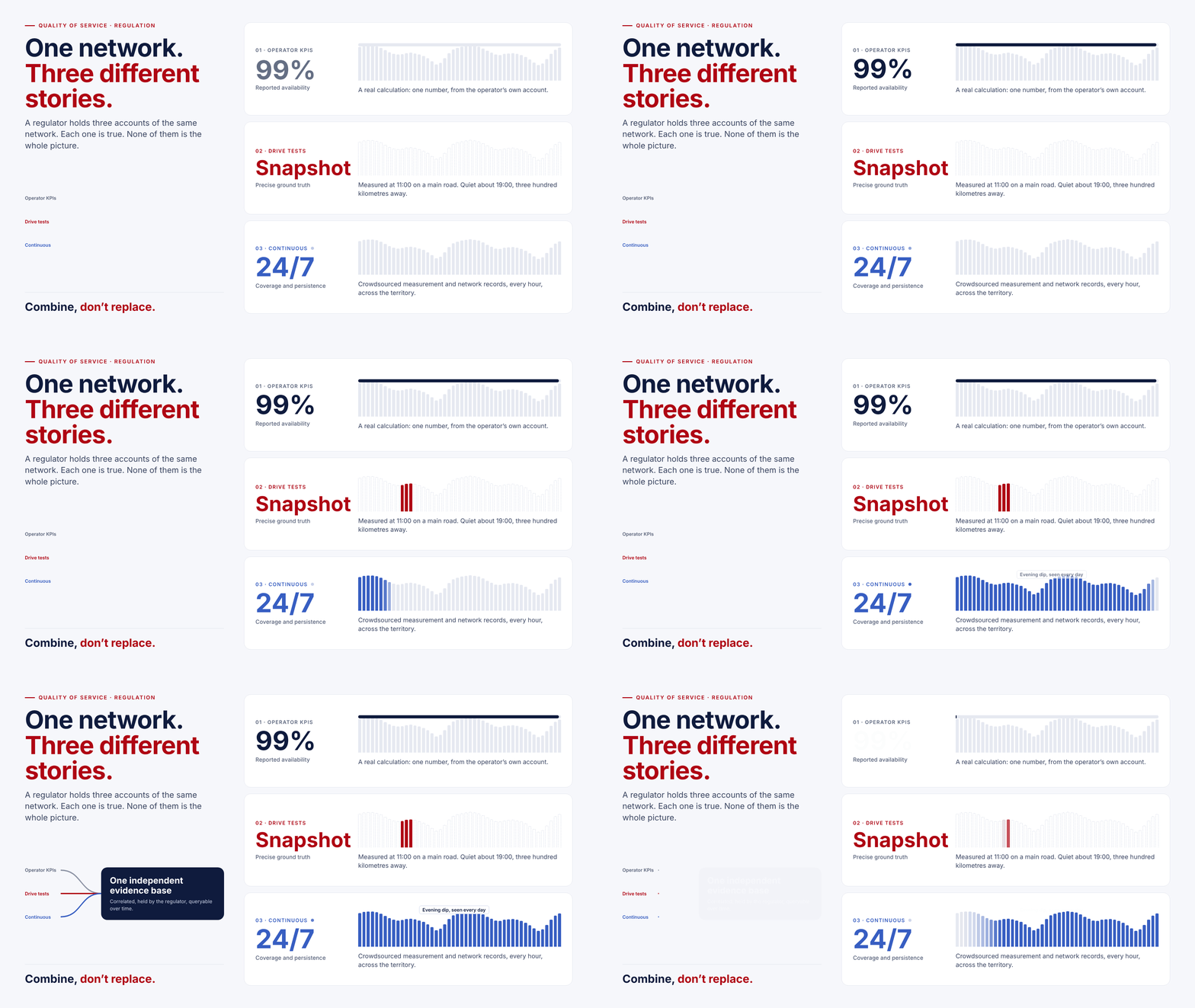
A regulator’s authority over quality of service rests on the evidence it can stand behind. The instruments the field relies on are each valuable (operator KPIs, drive tests, consumer surveys) but each captures a moment, and network quality is not a moment. It’s a living thing that varies by hour, by cell, by place, and a picture assembled from occasional snapshots will always leave gaps that an operator can point to and a subscriber can fall into.
The way forward isn’t to abandon any of these instruments , it’s to combine them. Rigorous drive-test measurement for precision and ground truth. Continuous, crowdsourced measurement for coverage and realism. Operator records for what the network itself reports. Correlated into a single, independent evidence base, held by the authority and queryable over time, they turn three accounts that never quite reconcile into one record that does.
That shift (from periodic snapshots to continuous, independent evidence) is the same one reshaping how regulators verify revenue and traffic. For quality of service it matters just as much, because quality is where the gap between what’s reported and what’s experienced is most visible to the public the regulator serves. How that evidence base is actually built (bringing these measurement sources together and correlating them) is the subject of the companion to this piece.