Why Your Bank’s Fraud Engine Blocks Too Much: The Cost of False Positives
For most banks, the more expensive fraud problem isn’t the fraud that gets missed. It’s the fraud that gets flagged and turns out not to be fraud at all.
A monitoring engine that blocks too much feels, from the inside, like it’s working hard. From the outside, where your customers are, it feels like being told your own money is suspicious. Both are expensive, and the second is expensive in a way that rarely shows up on the fraud team’s own dashboard.
This is the false positive problem, and it is the quiet tax on almost every transaction monitoring system a bank runs. It is worth being precise about what it actually costs, because the cost is larger and spread wider than the number of alerts would suggest.
What a false positive really costs
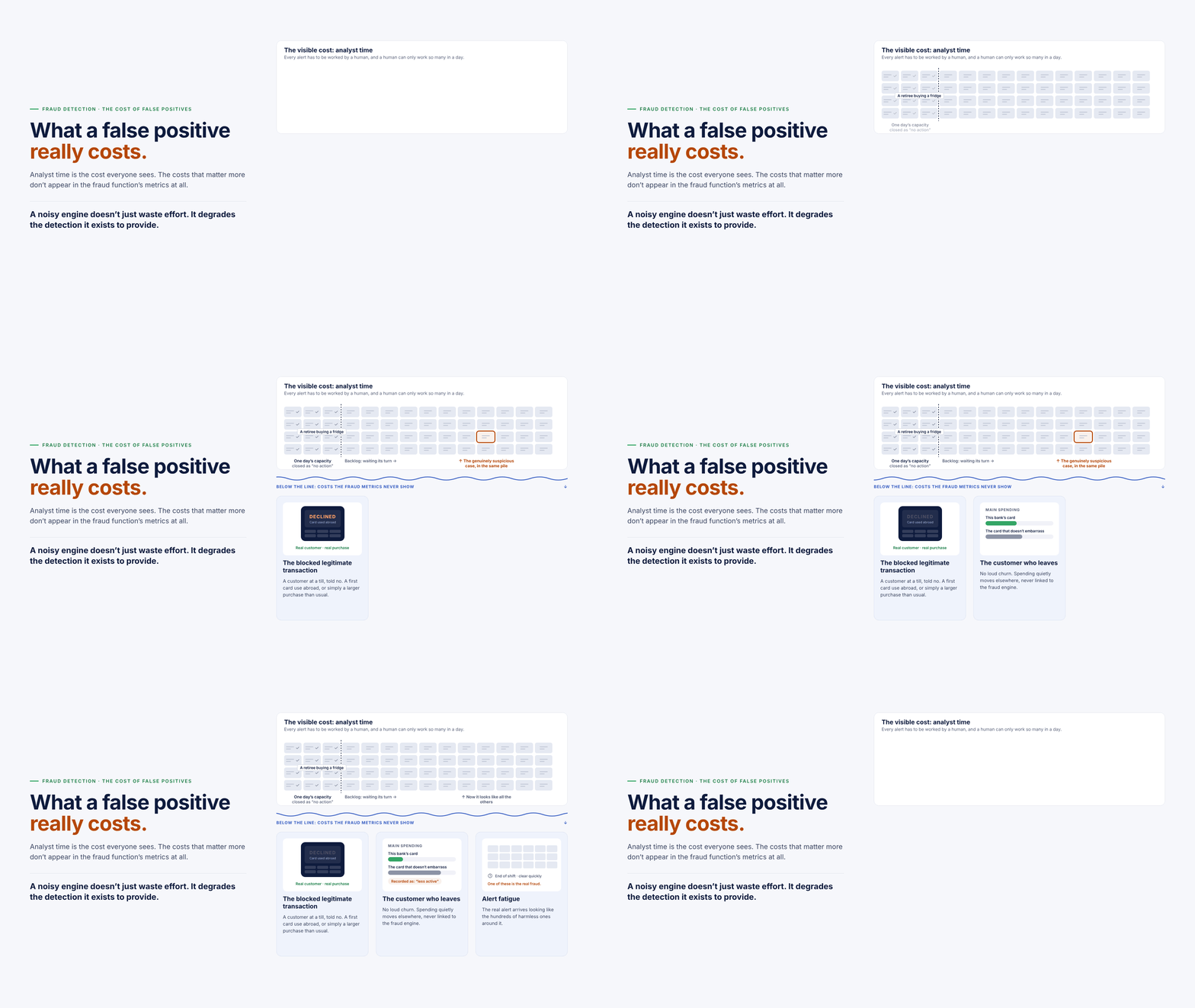
The visible cost is analyst time. Every alert that fires has to be worked by a human, and a human can only work so many in a day. When the bulk of what lands in the queue turns out to be legitimate, your most skilled people spend their hours clearing noise rather than catching fraud. The queue grows, the backlog grows, and the genuinely suspicious case sits in the same pile as the retiree who happened to buy a fridge, waiting its turn behind hundreds of alerts that will all be closed as “no action.”
That is the cost everyone sees. The costs that matter more are the ones that don’t appear in the fraud function’s metrics at all.
There is the blocked legitimate transaction. A customer tries to pay, the engine declines it, and the customer is standing at a till or sitting at a checkout being told no. Sometimes it’s a card used abroad for the first time. Sometimes it’s simply a larger purchase than usual. The transaction was real, the customer was real, and the bank just told them their money was in question. That moment does damage that no fraud metric captures.
There is the customer who leaves. The second or third time a card is wrongly declined, trust goes, and trust is the entire product a bank sells. People do not churn loudly over a false decline. They quietly move their main spending to the card that doesn’t embarrass them, and the bank records it as a customer who became less active, never connecting it to the fraud engine that drove them away.
And there is the cost that is almost poetic in how it undermines the whole purpose: alert fatigue. When analysts spend all day clearing false positives, the real one is harder to see, not easier. It arrives looking exactly like the hundreds of harmless alerts around it, at the end of a shift, in a queue everyone has learned to clear quickly. A noisy engine does not just waste effort. It actively degrades the detection it exists to provide.
Why turning the dials down isn’t the answer
The obvious response to too many false positives is to loosen the rules. Raise the thresholds, relax the checks, let more through. And it works, in the sense that the alert volume drops. It also lets more fraud through, because you have not made the engine smarter, you have just made it quieter by asking it to look less hard.
This is the bind every fraud team knows. Tighten the rules and you catch more fraud and more innocents with it. Loosen them and you spare the innocents and the fraudsters together. The dial trades false positives against false negatives, and moving it does not escape the trade, it just chooses which error to make more of. Teams end up living at an uncomfortable setting that is too loose to feel safe and too tight to feel fair, because there is no setting on that dial that is actually good.
The reason the dial is such a blunt instrument is that it is reacting to the wrong thing. A threshold looks at a transaction in isolation and asks whether this one amount, at this one time, in this one place, crosses a line. But almost nothing about whether a transaction is fraudulent is contained in the transaction itself. It is contained in the context: who this customer is, what they normally do, what else is happening around this payment. A system that only sees the single transaction is forced to guess from too little, and a guess from too little is exactly what produces both false positives and false negatives.
The real problem is missing context, not a mis-set threshold
Here is the heart of it. A large transfer is suspicious in the abstract and completely normal for a customer who makes large transfers every month. A foreign transaction is a red flag for someone who never travels and a Tuesday for someone who does. A new payee is alarming for an account that rarely adds one and routine for a small business paying new suppliers constantly. In every one of these, the transaction is identical. What differs is the context, and context is what a threshold cannot see.
So the false positives are not really a sign that the thresholds are set wrong. They are a sign that the engine is being asked to judge transactions without knowing the customers they belong to. It flags the retiree’s fridge because it has no model of what the retiree normally does. It would wave through a genuinely anomalous payment from that same retiree if the amount happened to sit under the threshold, because it is not comparing the payment to that person’s behaviour, it is comparing it to a global line that treats everyone the same.
The way out is not a better threshold. It is a different question. Instead of asking “is this transaction over the line,” the engine needs to ask “is this transaction normal for this customer.” That reframes the whole problem. A payment that is perfectly ordinary against a global rule can be glaringly out of character for one specific person, and a payment that trips a global threshold can be entirely in character for another. Judged against the individual’s own established behaviour, the retiree’s fridge is unremarkable and the anomaly stands out, which is exactly the opposite of what a flat threshold achieves.
Why this has been hard to do
If behavioural context is the answer, the fair question is why banks haven’t simply done it. The reason is not that nobody thought of it. It is that comparing every transaction, in real time, against a deep history of that specific customer’s behaviour is demanding in a way that traditional systems were not built for.
It needs history, and a lot of it. A meaningful sense of what is normal for a customer cannot be built from a few weeks of data. It needs enough history to know this customer’s genuine patterns across seasons, across pay cycles, across the ordinary irregularity of a real life. It needs that history queryable fast, in the moment a transaction is being authorised, not in a batch report that runs overnight. And it needs the behavioural picture to span the places a customer’s activity actually lives, which is rarely one system. The result is that behavioural baselining, the thing that would cut false positives and catch more real fraud at the same time, has historically been expensive enough that many institutions settled for the blunt dial instead.
That constraint is what has changed, and it is the subject of the companion to this piece. The short version is that holding deep behavioural history and querying it at the speed of a transaction is no longer the barrier it was, which means the dial is no longer the only option.
The question worth asking your own team
Before any of that, there is a question worth putting to your own fraud function, because the answer tells you how much the noise is actually costing you:
Of the alerts your engine raised last month, what shares were closed with no action? And of the customers who became less active this year, do you know how many had a legitimate transaction wrongly declined first?
Most teams can answer the first question, and the number is usually uncomfortable. Almost no team can answer the second, and that is the point. The cost of a noisy fraud engine is not mainly the alerts you can count. It is the trust you cannot, draining quietly from customers who were never doing anything wrong, flagged by a system that never knew them well enough to tell.